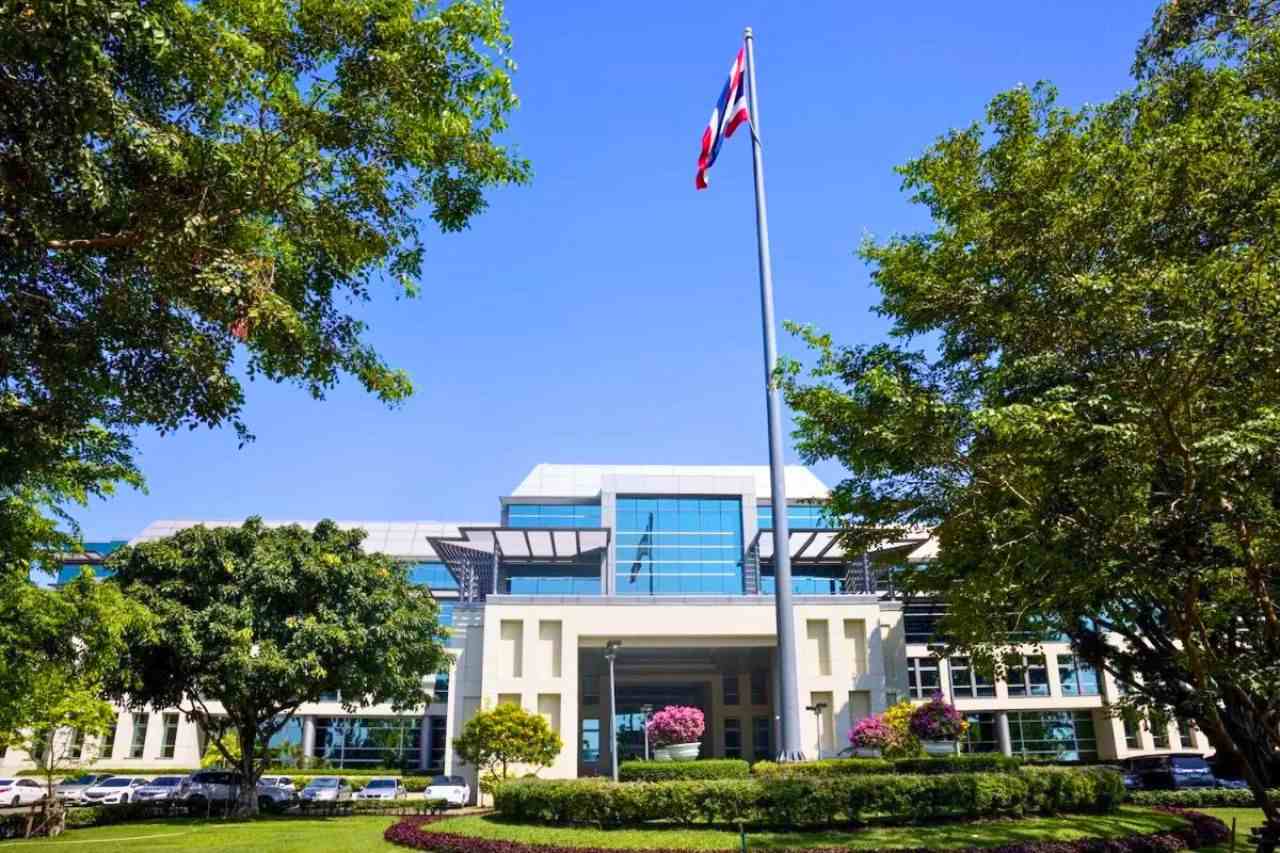
The Bank of Thailand (BoT) has lowered its interest rate to 1.25% on Wednesday, December 17, 2025, as economic risks accumulate.
The Thai central bank has unanimously decided to lower its benchmark interest rate by 25 basis points, bringing it down from 1.50% to 1.25% with immediate effect, and announced that it will continue to ease its monetary policy to support economic growth.
The Monetary Policy Committee (MPC) of the central bank is seeking to support an economy weakened by several factors, including political uncertainty, the strengthening of the baht and US tariffs.
This is the fifth rate cut since October 2024, with rates reduced by a total of 125 basis points during this period.
Thirteen of the 23 economists surveyed by Reuters expect the key rate to fall to 1.00% in the first quarter of 2026.
The other ten expect it to remain at 1.25%.
"The MPC assessed that Thailand's economic outlook showed a more pronounced slowdown compared to the previous meeting," said Sakkapop Panyanukul, MPC Secretary,in a statementreleased after the meeting.
The National Economic and Social Development Council (NESDC) expects Thailand's GDP growth to slow to 1.7% next year, down from 2% this year, according to estimates.
The economy grew only 1.2% year-on-year in the third quarter, down from 2.8% in the second quarter.
Growth in the fourth quarter is expected to be less than 1%.
The BoT expects the economy to continue slowing in 2026 and 2027 compared to the first half of 2025.
It expects growth to be 1.5% in 2026, improving to 2.3% in 2027, but remaining below potential and well below the performance of other Southeast Asian countries.
In 2026, the economy is expected to slow down compared to this year, largely due to weaker private consumption, along with more moderate income growth, as well as a decline in merchandise exports due to US tariffs.
Export growth is expected to slow to 0.6% in 2026, down from 12% this year, largely due to anticipation effects and a high base.
Tourism remains a key driver of the Thai economy, with 33 million foreign visitors expected in 2025, 35 million in 2026, and 36 million in 2027, according to the statement.
However, it remains insufficient on its own to revive growth, despite an increase in spending per visitor despite a more moderate arrival volume.
See: Decline in tourism in Thailand: only 32 million visitors in 2025
Low inflation, but credit continues to contract

Customers in a supermarket in Thailand.
Demand-driven inflationary pressures are limited, given that economic growth remains below its potential, the MPC said.
The BoT expects inflation to remain below its target of 1 to 3% in the longer term, with forecast averages of -0.1% for 2025, 0.3% for next year and 1.0% for 2027.
Interest rates across the banking system and financial markets have fallen, in line with previous reductions in key rates, which has helped reduce financing costs and ease the debt burden on businesses and households.
But credit continues to contract and the credit quality of vulnerable borrowers continues to deteriorate.
Small businesses are facing liquidity problems due to both limited access to credit and the strengthening baht, the MPC added.
On Wednesday afternoon, the Thai currency was trading at around 31.53 to the US dollar, a level close to its four-year high and virtually unchanged from the previous day.
This Friday, December 19, 1 euro is worth 36.79 baht and 1 US dollar is worth 31.44 baht, levels that suggest the rate cut has not yet had a significant impact on the baht's trajectory.
See: Thai baht (THB) exchange rate: daily rate against the euro
The baht has appreciated by 8.2% against the dollar since the start of the year.
At the last MPC meeting in October, the appreciation rate was only 3.2%.
"The central bank is monitoring the baht more closely and has strengthened measures to manage exchange rate fluctuations," said Mr. Sakkapop.
See: The spectacular rise in the Thai baht worries the Central Bank
Serious concerns about economic prospects
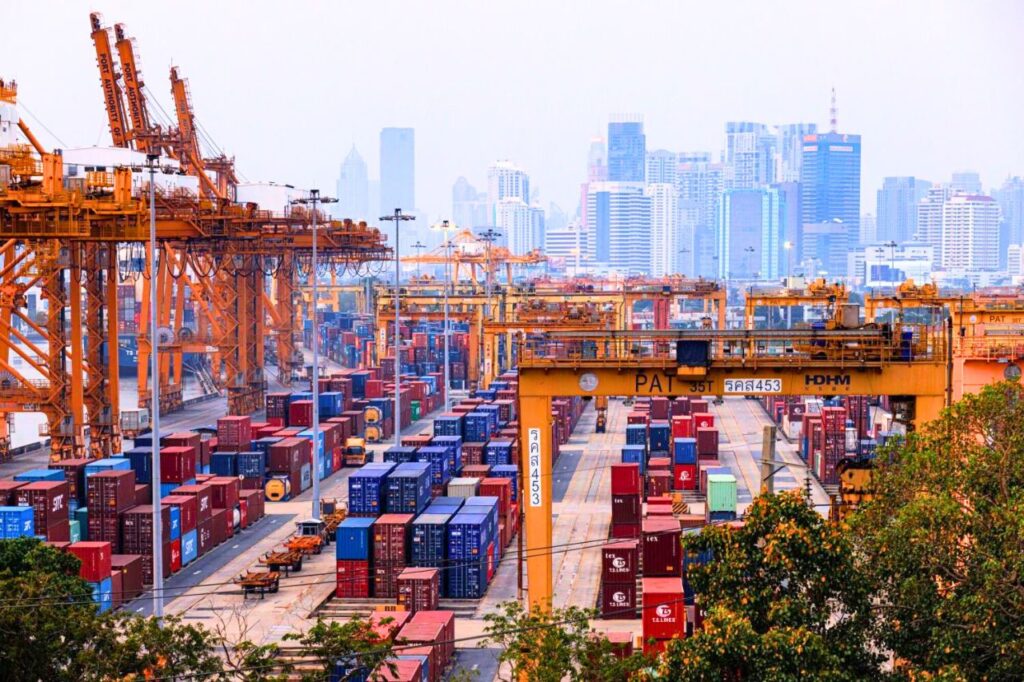
Cranes and shipping containers in Bangkok port. Photo: Bangkok Post.
Nattaporn Triratanasirikul, Deputy Managing Director of Kasikorn Bank's research center (K-Research), said the unanimous decision to cut the rate reflects the committee's concerns about the country's economic prospects.
“As Parliament has already been dissolved, fiscal policies and budgetary expenditures will progress slowly and could be disrupted under the interim government,” she said.
“The second phase of the ‘Khon La Khrueng’ co-payment program, which was to be launched to stimulate domestic consumption, has now been suspended.”
Ms. Nattaporn said it was time for monetary policy to play a more important role in reviving a sluggish Thai economy.
K-Research expects economic growth to slow to 1.6% in 2026, down from an estimated 2% this year.
The think tank expects the slowdown in exports and weakness in domestic consumption to weigh heavily on the economy next year.
Exports are expected to contract by 1.2% next year, after supporting Thai growth in 2025 with an 11% increase, thanks to anticipated shipments before the US tariffs come into effect.
The conflicts between Thailand and Cambodia have led K-Research to predict that the border between the two countries will remain closed for the first six months of 2026.
This could lead to a contraction in Thai exports to Southeast Asia compared to the previous year, said Ms. Nattaporn.
In a context of political uncertainty, a strong baht and global slowdown, monetary policy now appears to be one of the last levers available to Thailand to support an economy under pressure.
- The Bank of Thailand has lowered its key rate from 1.50% to 1.25% to support a slowing economy.
- This is the fifth rate cut since October 2024, for a total of 125 basis points.
- Economic growth is expected to remain weak in 2026, hampered by sluggish consumption, a strong baht and declining exports.
- Inflation is not a pressure factor, but credit continues to contract, particularly for households and small businesses.
- Tourism remains a pillar of the economy, but is not enough to compensate for the general slowdown.
See also:
In the face of global shocks, Thailand accelerates its economic transformation
Thailand-Cambodia crisis: alert on a major economic impact
Thailand's welfare economy exceeds 670 billion baht
Thailand's economy "on the brink"
Thailand's new plan for tourism and economic recovery
Source: Bangkok Post
Prepare your trip to Thailand
Book bus, train, or boat in Thailand
Manage your money while traveling with Wise
If our news, tourist information, or cultural content has been useful to you and you'd like to thank us:
You can follow us on:
Twitter, LinkedIn, Facebook, Google News
Or install our app:
Install the Toute la Thaïlande app on your smartphone

1 comment
This rate cut will be completely ineffective, and for several reasons: as usual, this reduction (of 0.25%) in the key interest rate is insufficient to shift the fundamentals of a baht whose value was 36.80 baht/1 euro last night.
This morning, the baht is trading at 36.84 baht/1 euro and should, in principle, break through the 37 baht barrier in the coming days, although it will not be spectacular and will not significantly impact international export transactions and international tourism figures!!!
Secondly, the Thai domestic economy will remain gloomy, with household debt remaining high and a concern, between 86 and 90% of GDP for all Thai households, who, despite very low inflation, do not see their purchasing power and daily well-being increase significantly, because apart from energy products (electricity, gas and petrol) which either stagnate or have decreased slightly in 2025 compared to 2024, many consumer goods and even basic food necessities have increased significantly, particularly fruits and vegetables, as well as services or general labor.
For the year 2026, Thai economists are already predicting a decline in exports given this status of currency 'expensive' to buy and trade compared to other neighboring Asian countries.
And what doesn't help, this situation of uncertain economic future, encourages Thais to buy gold, considered as a safe haven and the only current way to guarantee a medium and long-term financial security, and this has the effect of keeping a strong baht against the rise in gold purchases (jewelry and ingots) by Thais.
In short, the Bank of Thailand's timid interventions and the hope of seeing the baht trade above 38.50 to 40 baht per euro are currently, and I'm afraid for 2026, a sweet waking dream…
Unless the election results come to disrupt a political future that is struggling with a general mistrust of its traditional elites, with the logical consequence of increased instability and a general weakening of the overall national economy…
Nothing very cheerful at the end of the year !!!