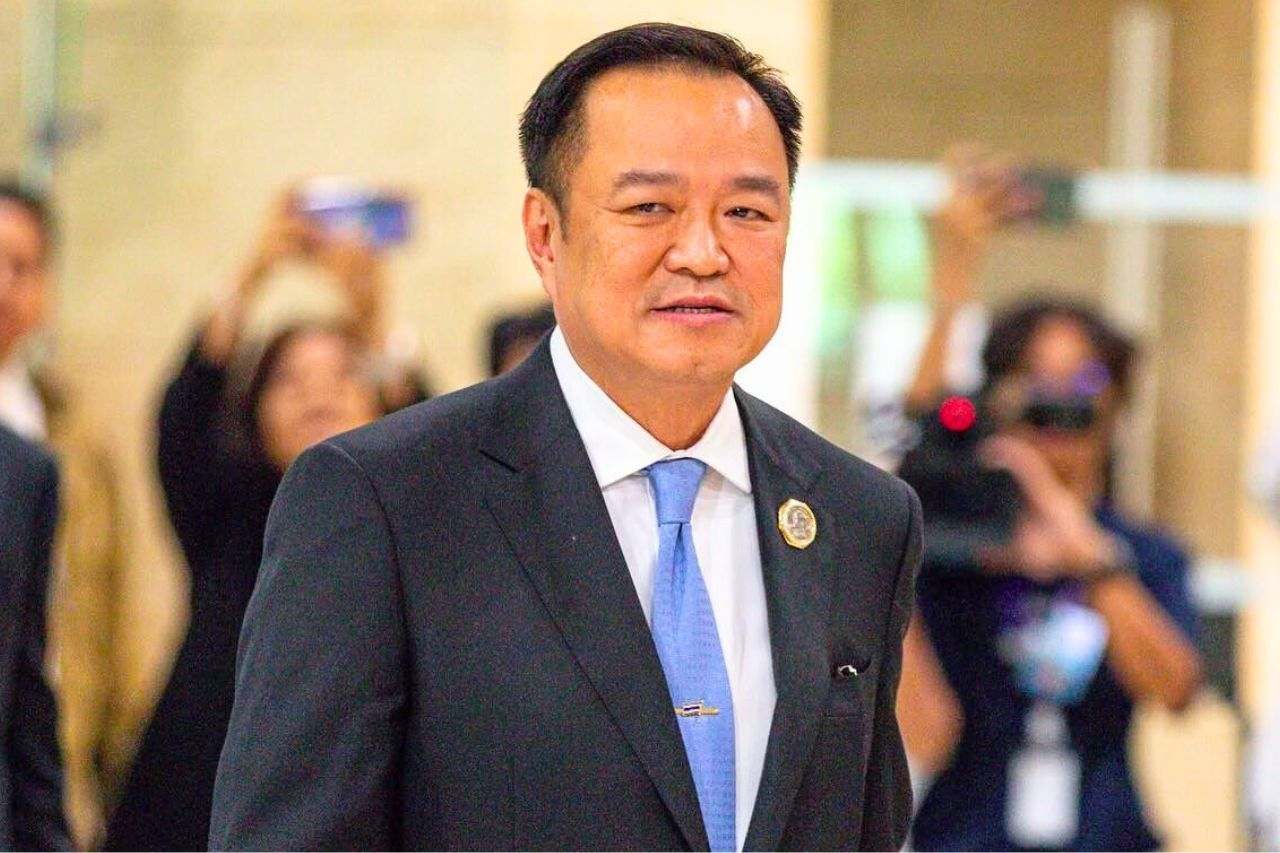
Between political crisis and economic slowdown, Anutin's minority government has four months to act.
A minority government, led by Anutin Charnvirakul of the Bhumjaithai party, is currently being formed after the opposition party, the People's Party, facilitated its creation without joining the administration.
See: Thailand: Anutin Charnvirakul elected 32nd Prime Minister with a majority of votes
The Parliament has recently voted to allow an interim government to function for four months before dissolving the lower house.
The People's Party orchestrated this move without joining the government, in order to end the political deadlock resulting from the Constitutional Court's verdict that removed Prime Minister Paetongtarn Shinawatra.
This was the second setback for the Pheu Thai party after its predecessor, Srettha Thavisin, suffered the same fate before the same court in August 2024.
A Thailand weakened by political instability
Anutin has accepted the conditions set by the People's Party to gain its support.
Political observers continue to debate the merits of the Popular Party's decision to offer its support from outside.
Some believe that this decision risks strengthening the Bhumjaithai, a conservative populist party.
Many wonder if Bhumjaithai will keep its promise or attempt to put in place a strategy to stay in power longer than the agreed four months.
Thailand is facing not only a political crisis but also a serious economic slowdown.
Some economists have described Thailand's economic performance as 'lost decades', referring to the sluggish growth over the past 20 years.
Economically, it could be practically impossible to bring about significant changes in just four months, given the scale of the challenges to be addressed.
It may, however, be possible to support the economy and prevent further deterioration.
Four months to reassure the Thai economy
Some clarification of the political situation has slightly improved market sentiment:
The Thai stock exchange index gained 12.25 points, or 0.98%, to close at 1,264.80 on September 5, the day Anutin received parliamentary approval to form a new government.
However, this increase cannot be entirely attributed to domestic politics: analysts point out that expectations of a cut in US Federal Reserve rates have also boosted the market.
Anutin's Economic Choices and His Team
Anutin has invited external experts to join the government, with the aim of demonstrating his commitment to competent leadership.
Ekniti Nitithanprapas, Director-General of the Treasury Department, is expected to become the new Finance Minister.
Mr. Ekniti is a veteran of the Finance Ministry, having previously headed the Revenue and Excise Departments.
Another notable name is that of Auttapol Rerkpiboon, former CEO of PTT, Thailand's largest energy company, known to be a hybrid entity both state-owned and managed as a public company.
The question of short-term stimulus measures
Observers debate whether the new government should implement a short-term stimulus plan to support the economy, which risks being hit by Trump's aggressive tariff policy in the second half of the year.
See: Trump Imposes 19% Tariff on Thailand and Cambodia
Opinions diverge: on the one hand, a short-term stimulus is necessary to help the population cope with the rising cost of living; on the other hand, the government has already accumulated significant budget deficits.
"I won't agree if the government launches a populist policy by distributing money for free, as the Pheu Thai-led coalition did," said Professor Praipol Koomsup, an independent economist.
“The government should instead support projects that improve productivity, such as short-term training, for example, training in artificial intelligence to improve the skills of workers in the field of information technology.”
Bhumjaithai party leaders are discussing the possibility of reinstating the co-payment system, which helps consumers buy essential products by offering them limited financial support from the government.
This system was put in place between 2020 and 2022 by the government of Prayut Chan-o-cha during the COVID-19 crisis.
It has proven popular and has been considered effective in supporting low- and middle-income groups during the economic crisis.
Anusorn Tamajai, Dean of the Faculty of Economics at the Thai Chamber of Commerce University, said:
« I would agree that the new government restore the co-payment system, as it would help the local population, namely low-income consumers and small businesses ».
The energy challenge and the cost of electricity in Thailand
Complaints about the high cost of electricity have been frequent, but previous governments have not been able to resolve this issue.
They have exposed themselves to criticism for their policies favoring large companies, particularly power plants, at the expense of consumers and other sectors.
“The government should complete the ongoing Power Development Plan (PDP),” said Professor Praipol, an expert in energy economics.
He suggests that the PDP may require some minor adjustments, such as improving the accuracy of future energy demand forecasts.
The previous national energy plan had overestimated economic growth and energy demand, particularly for electricity.
This has led to over-investment in electricity production under the public-private partnership program; the resulting burden has been passed on to households and businesses, which now face higher electricity costs.
According to Praipol, the government should continue to support the installation of rooftop solar panels through financial or tax incentives.
He also suggests liberalizing the electricity trade, which is currently monopolized by the state-owned Electricity Generating Authority of Thailand.
Boosting tourism in Thailand
Supporting tourism could bring significant economic gains, as Thailand is heavily reliant on foreign tourist spending.
Tourism revenue accounts for 12 to 13% of gross domestic product.
According to the Ministry of Tourism and Sports, 21.9 million tourists arrived in the first eight months of this year, a decrease of 7.16% compared to the same period last year.
These tourists generated around 1,000 billion baht in revenue, a decrease of 5.4%.
In August, the Paetongtarn government launched the Tourist Digipay program, which allows foreign tourists to exchange cryptocurrencies for baht and spend them in Thailand.
See: Traveling to Thailand with cryptocurrencies: the country launches TouristDigiPay
Through the implementation of regulations and infrastructure, the previous government planned to implement it in the fourth quarter and hoped it would encourage tourists to spend 10% more.
It is not yet known whether the new government will continue this program.
Observers suggest that this program could facilitate the conversion of cryptocurrencies, but it is unlikely to boost tourism.
“Due to the administrative formalities linked to the registration process, I don't think it would help stimulate tourism,” said Nares Laopannarai, president of the Thai Digital Asset Association.
Associate Professor Nada Chunsom of the National Institute of Development Administration shares this view, stating that the program is unlikely to increase tourist spending by an additional 10%.
Even if it could create an optional channel for tourist spending.
Normalizing border trade with Cambodia
All eyes are on whether the new government will quickly reopen the border with Cambodia for economic reasons, following the deadly military clashes in July.
"It is perfectly normal to want to improve the situation, but it is too early to hope for a normalization of border trade with Cambodia due to the escalation of conflicts," says Praipol.
Accelerate budget disbursement
Many economists hope that the government will accelerate budget disbursement, which is essential to support the economy.
Budget deficits have increased in recent years and are expected to reach 4.3% of GDP in the 2026 budget bill, which is pending in the Senate.
The government's net revenue in the first ten months of fiscal year 2025 (October 2024-July 2025) amounted to 2,250 billion baht, missing the target by 37.6 billion baht, or 1.6%.
Anusorn warned:
“The government must spend wisely and avoid creating more debt, as international rating agencies could lower Thailand's sovereign rating due to reduced fiscal space.”
Tariff negotiations with the United States
Thailand and the United States are still negotiating a trade agreement after the United States imposed a 19% tariff on Thai products.
Thailand is also facing the risk of a 40% tariff on goods transshipped via Thailand (if other countries are allowed to export goods to the United States via Thailand).
The agreement remains uncertain, as a US appeals court recently ruled that most of the tariffs imposed by Trump were illegal, explains Praipol.
Between political instability and colossal economic challenges, Anutin's minority government has only four months to convince and avoid economic wreckage.
It remains to be seen whether this will be a mere reprieve… or a springboard to prolong its power.
See also:
Thailand in full political chaos: the end of the Shinawatra dynasty?
Thailand: 42% of citizens have lost all hope in political parties
Political crisis in Thailand: between the risk of a coup and border chaos
Source: Thai PBS World
Prepare your trip to Thailand
Book bus, train, or boat in Thailand
Manage your money while traveling with Wise
If our news, tourist information, or cultural content has been useful to you and you'd like to thank us:
You can follow us on:
Twitter, LinkedIn, Facebook, Google News
Or install our app:
Install the Toute la Thaïlande app on your smartphone

2 comments
He should ask foreigners in Thailand from various countries to give him advice… if that were possible.
What an excellent idea, Gaspard !!!
But it's like asking a polar bear to eat salad…
Never a Thai (let alone if he is a politician) will lose face by seeking advice from a "farang" to guide his decisions in favor of the well-being of the country and its population; it would be an admission of weakness and incompetence…
There was, among other examples, many years ago, a precedent during the consultation of Dutch experts on the solutions to be brought to avoid the catastrophic floods that Thailand experiences every year with its lot of destruction of crops, domestic animals, movable and immovable property and the loss of human lives…
The Dutch experts (the best in the world in this field) have presented studies and solutions to be implemented to avoid these floods and learn to channel them, as they have done at home with the famous 'Delta plan' to conquer land on the North Sea, land that is sometimes several meters below sea level!
Well, this plan, adapted to Thailand and which could have since saved thousands of people and devastated regions, has remained a dead letter and is probably currently gathering dust at the bottom of a ministry drawer, if it hasn't been shredded!!!
And to give some advice to Anutin (yes, yes, even if my opinion is useless), I would tell him to start by tackling the parity of the baht against gold, the dollar and the euro, instead of letting it rise to a value well beyond its current worth to boost the Thai economy, which is at its worst…
Currently, all indicators are turning from orange to red, and nothing is changing, on the contrary…
The baht continues to cost more and more, weighing down international trade and giving the economic world the image of a Thailand that is becoming more and more expensive compared to other Asian countries, direct economic competitors…
We can hardly do better to prepare for the financial bankruptcy of the Kingdom in the medium term… if nothing changes in the coming months.