
The poverty rate has increased in Thailand in 2024 to reach 4.9% of the population, or 3.4 million people.
- Poverty is progressing despite slight economic growth in 2024.
- 4.3 million "near-poor" remain at high risk of falling below the official threshold.
- Pattani and Mae Hong Son are among the most affected provinces for more than 15 years.
- The agricultural sector (9.6%) and households with children (8.7%) are the most vulnerable.
- The social assistance system remains fragmented, hindering the fight against intergenerational poverty.
The National Economic and Social Development Council (NESDC) stressed that the problem is deeply rooted in several provinces, where inequalities remain difficult to reduce, with the majority of poverty being concentrated in the agricultural sector.
The NESDC has reported on the progress made within the framework of the 13th national economic and social development plan (2023-2027).
Over the first two years of the plan, despite efforts to implement various initiatives, the distribution of economic opportunities across sectors has not effectively reduced regional disparities, particularly in terms of poverty reduction.
The institution believes that poverty is now showing signs of becoming chronic.
Unlike in the past, when poverty generally decreased as the economy developed, in 2024, the trend has reversed despite slight economic growth.
During the COVID-19 pandemic (2019-2023), the poverty rate continued to decline, largely due to government aid and economic stimulus measures.
In addition, Thailand still has a group of 'near-poor' - those whose spending does not exceed the poverty line by more than 20% - with 4.3 million people at high risk of falling back into poverty.
Moreover, poverty remains deeply entrenched in certain regions, such as Pattani and Mae Hong Son, which have had the highest poverty rates in the country for over 15 years.
Poverty is also closely linked to other factors.
Most poor people have a level of education less than or equal to primary level, and the majority of them live in the agricultural sector, where the poverty rate is 9.6%.
In addition, households with children aged 6 to 14, which have the highest poverty rate (8.7%), are also particularly vulnerable.
This is partly explained by the high cost of living and by the fact that household members responsible for caring for children have fewer opportunities to work, making these households more vulnerable to a worsening of their situation.
The NESDC acknowledges that poverty reduction has mainly focused on providing short-term financial assistance to alleviate difficulties.
Meanwhile, efforts have been made to improve the accuracy of identifying and targeting the most vulnerable groups.
Examples include:
- Improving benefits within the framework of the social card program
- increasing family allowances in the social security system
- promoting wider access to child education assistance for all eligible families
The council has also worked to develop more effective, data-driven mechanisms to improve aid programs.
In terms of social protection, the NESDC has made efforts to expand benefits and coverage to target groups, integrating data on vulnerable populations to make the social assistance system more systematic.
The challenges of reducing intergenerational poverty
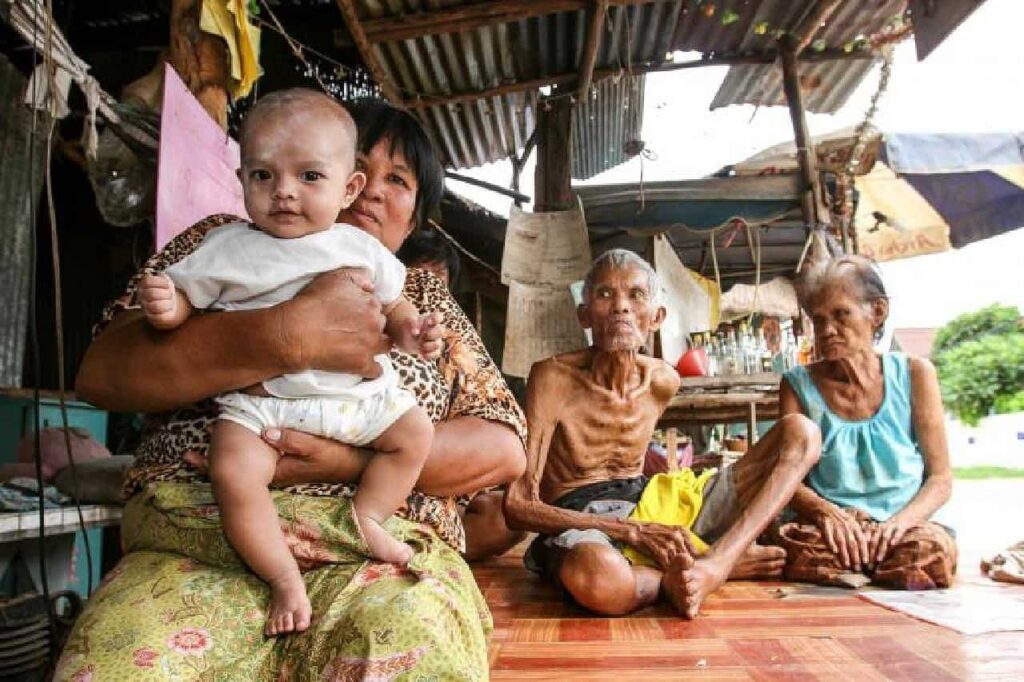
Thai family. Photo: Aphiluck Puangkaew – UNICEF
Despite progress made, several challenges persist in efforts to reduce intergenerational poverty.
Among the main limitations, we can cite the lack of adequate incentives for local agencies to fight poverty, as performance evaluation indicators do not favor effective action at the local level.
There is also a lack of continuously collected longitudinal data, which undermines the accuracy and effectiveness of anti-poverty policies.
One of the main challenges of the social protection system is the fragmentation of services, which leads to overlaps for certain target groups and gaps for others, harming the effectiveness of the system and resulting in a waste of budgetary resources.
While many sectors now recognize the urgency of these issues and are making ongoing efforts to address them, the integration of work from policy to practice remains slow.
Structural challenges such as data sharing between agencies, disconnection of public service management systems, and legal obstacles hinder the progress of these integrated efforts.
See also:
2.39 million people in Thailand still live in poverty
Millions of people in Thailand risk falling into poverty
Source: The Nation Thailand

2 comments
3.4 million (very) poor people and 4.3 million Thais on the verge of poverty…
If we add up the two percentages, that makes 7.7 million Thais living in definite poverty and unable to afford, at best, just enough to feed and house themselves in conditions of (un)comfort close to what would be classified as unsanitary housing in our country…
That's between 11 and 12 Thais out of 100... that's a lot!!!
And given the current geopolitical situation which is generating global economic instability, affecting the most vulnerable social classes the hardest (as always in these situations), the situation of the "poor and near-poor" is not going to improve in the short or medium term…
Maybe in 2029, when Trump is a "retired" president and can no longer play bowling with the global economy!!!
The figure of 2.39 million is probably wrong…
I had estimated it at almost 10 million, taking into account the very large number of family reunifications…
Many children start out with less than ideal conditions.
But their smiles erase everything.
They are an extremely resilient people.