
The imminent introduction of the digital entry card (TM6) in Thailand has left many potential visitors in confusion.
See: Everything about the Thai Digital Arrival Card (TDAC) in Thailand: the guide
Questions regarding its implementation remain unanswered a few weeks before its scheduled launch.
As of May 1st, all non-Thai passport holders traveling to the country will be required to complete an online form, the Thai Digital Arrival Card (TDAC), before their arrival.
This measure is intended to replace the defunct TM6 arrival card, which travelers and immigration officials found cumbersome due to its small size and the frequent absence of pens within reach after long-haul flights.
The TDAC will require travelers to enter basic biographical information as well as details regarding their travel plans and accommodation.
The new system will apply universally to people entering by air, land or sea.
However, Thai authorities have not yet unveiled the precise digital platform designed to facilitate these submissions, leaving travelers and airlines in anticipation.
It is assumed that once travelers have submitted their contact information online, they will receive a confirmation in the form of a QR code.
This code can then be presented at immigration counters or possibly at electronic gates installed at certain Thai airports.
It also appears that the TDAC may serve as a customs declaration form, like the TM6, although no official confirmation has yet been provided.
Reports suggesting the introduction of an exit procedure similar to the TDAC have also surfaced, but they remain unfounded at this stage.
The distinction between the TDAC and a visa application has been a significant source of confusion.
Although these are separate procedures, a misunderstanding has raised concerns among tourists, particularly those from the 93 countries whose nationals are exempt from visa requirements for a 60-day visit, extendable by an additional month.
From May, these tourists, as well as all other foreign arrivals, regardless of their visa status, will have to go through the TDAC protocol.
Travelers are asking many questions
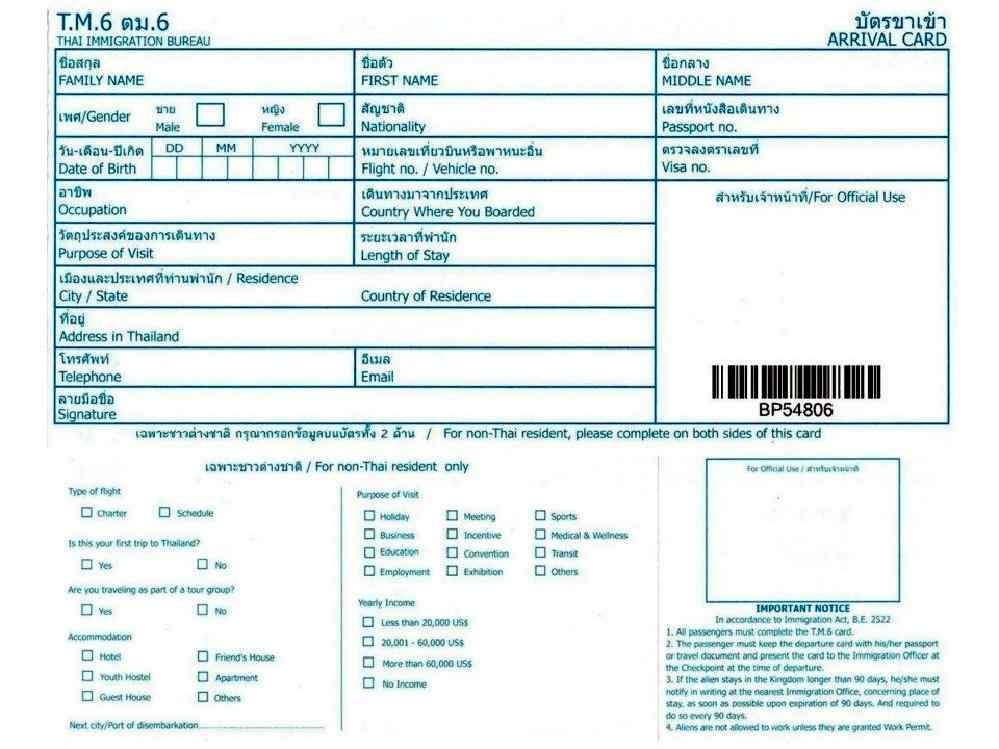
The TM6 card, now discontinued.
Several crucial questions remain unanswered:
Will passengers who have not completed the TDAC form be refused boarding by airlines, concerned about potential fines for transporting non-compliant passengers?
Will there be a mechanism for completing the TDAC form upon arrival?
Will each visit require the presentation of a new TDAC form?
What will happen if a traveler changes their accommodation after submitting their information?
Less than two months before the planned implementation of the TDAC, these and other questions require urgent clarification.
If Thai authorities do not communicate in a timely and thorough manner, the envisioned seamless travel experience could collapse even before it begins, leaving travelers and the tourism industry in a state of limbo.
See also:
Thailand's tourist tax will begin with air transport
Thailand launches a website to register and pay the tourist tax
Tourism in Thailand: a €100 billion bet for 2025
Thailand welcomed a record influx of tourists during the Chinese New Year
Source: Pattaya Mail
Prepare your trip to Thailand
Book bus, train, or boat in Thailand
Manage your money while traveling with Wise
If our news, tourist information, or cultural content has been useful to you and you'd like to thank us:
You can follow us on:
Twitter, LinkedIn, Facebook, Google News
Or install our app:
Install the Toute la Thaïlande app on your smartphone
⚠️ Cryptocurrencies involve risks: Invest only what you are willing to lose.

7 comments
As usual, with each launch of a new official application requiring the intervention of foreign tourists, and this time concerning arrivals, registrations and accommodation declarations of international tourists on Thai territory, the total computer fog characterizes once again the decisions of the authorities in their practical implementation.
Just like the 300 baht tourist tax whose implementation has been postponed several times since 2022, the risk of a general postponement of this access form to Thai territory by air, land or sea is not only very likely, or, if it is opened and available in the following weeks, will certainly encounter computer problems related to the number of requests that must be registered every day on this site.
If we refer to the 2024 figures, which saw more than 36 million tourists arrive in Thailand, this means that this site will have to "swallow" on average nearly 100,000 forms per day, 365 days a year without interruption, without fail, without "bug".
That would be a first!!! Cheers!!!!
This procedure already exists for entering Malaysia and Singapore and causes no problems.
Stop publishing this kind of sensationalist article.
Yes, vadis, absolutely right!, but no one is against the principle of this declaration and registration of foreign arrivals on Thai soil…
The problem is not there, because if it works without problems in Malaysia, in Singapore and in many other countries around the world, it's because where it works, it's because they have efficient computer tools and IT professionals capable of running them correctly…
The past IT experience of official Thai websites has proven to us on numerous occasions that the reliability of Thai Administration websites is far from being efficient, functional, and safe from bugs and repeated hacking!!!
It's a matter of competence, not ethics!
Forward the problem to Donald.
He will resolve it very quickly; a small decree, and it's done!!!
55555
At the same time, if the Thai administration were efficient, it would be known.
The order came from a minister and at the end of the day, it must be 3 IT interns, paid a minimum wage who have to work 7 days a week for it to work.
Delegating tasks is a highly appreciated Thai specialty in all administrations.
Not to mention the multitude of forms to stamp to move things forward.
I'm betting on a delay or a server crash on the day.
I wonder what it's for?
They already scan our passports upon arrival.
If it's to control the illegal activities of foreigners in the kingdom, I believe this form is totally useless, if not counterproductive!
Already because those who want to engage in illegal activity in Thailand, in relation to their visa, are the first to circumvent the law.
They are the most clever because they have a lot of experience and economic interests.
They know the flaws and share them.
They are very often part of a community, such as the Chinese, for example, and exchange tips (what works or not) to achieve their goals.
Of course, they practice corruption among officials.
Those officials are very interested in additional income…
As a result, they are fully integrated because they use the same methods as the Thais!
On the other hand, for the average tourist (i.e. the vast majority of arrivals) it creates additional obstacles that discourage some and therefore results in fewer foreign exchange earnings for Thailand!
To conclude, I believe the only real problem is respecting the law.
And for that, my Thai friends, there is no magic formula:
– Clear, sustainable, logical and acceptable laws.
– Access to regulations/laws facilitated by ultra-simple procedures.
– Stable enforcement of laws, equitable justice for all.
– A police force serving the judicial system, enforcing laws fairly and justly.
For a harmonious and prosperous Thailand, those who need to be monitored are civil servants and politicians, not entries and exits from the national territory...
Welcome to Big Brother…
In fact, Thailand is following Malaysia's example with this protocol, which will involve an application that will decide who can enter and who will not be able to enter.
Obviously, admission criteria will be modifiable over time.
The advantage will probably be a quick entry at the immigration level with the elimination of officials in charge of control.
Everything will be done by AI and will mark a further step towards permanent surveillance.
Moreover, everything is done to eliminate cash in Thailand with these payments via applications…
The future in the land of smiles is not so joyful.