
A few weeks from the high season in Thailand, analysts estimate that the decline in tourism should slow down the rise of the baht.
Every year, the baht strengthens during the high tourist season, but this time, the disaffection of Chinese tourists and expectations of lower interest rates are expected to curb this trend.
This Wednesday, October 22, at 8:45 a.m. (Thai time), 1 euro is worth 38.05 Thai baht and 1 US dollar is worth 32.83 baht.
See: Thai baht (THB) exchange rate: daily rate against the euro
The high season will not save the baht this year
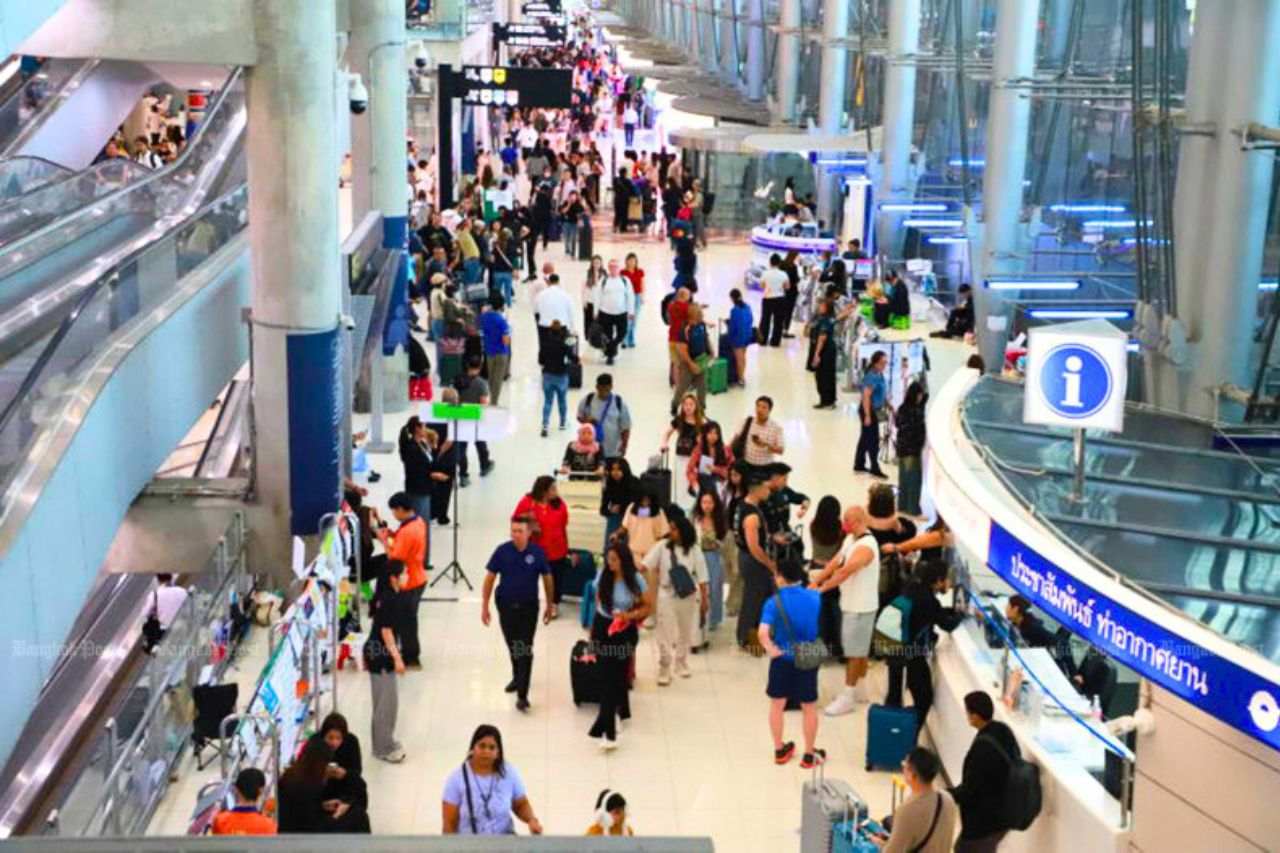
Passengers arrive at Suvarnabhumi Airport. Photo: Somchai Poomlard/Bangkok Post
The baht is expected to appreciate by around 1% against the dollar by the end of the year compared to the start of trading, according to a Bloomberg survey of strategists published on Tuesday, October 21, 2025.
This represents about half of the average gain observed over the past two months of the year over the past ten years.
According to Crédit Agricole CIB bank, the weakness of exports could also limit the rise.
Fewer tourists, less foreign currency
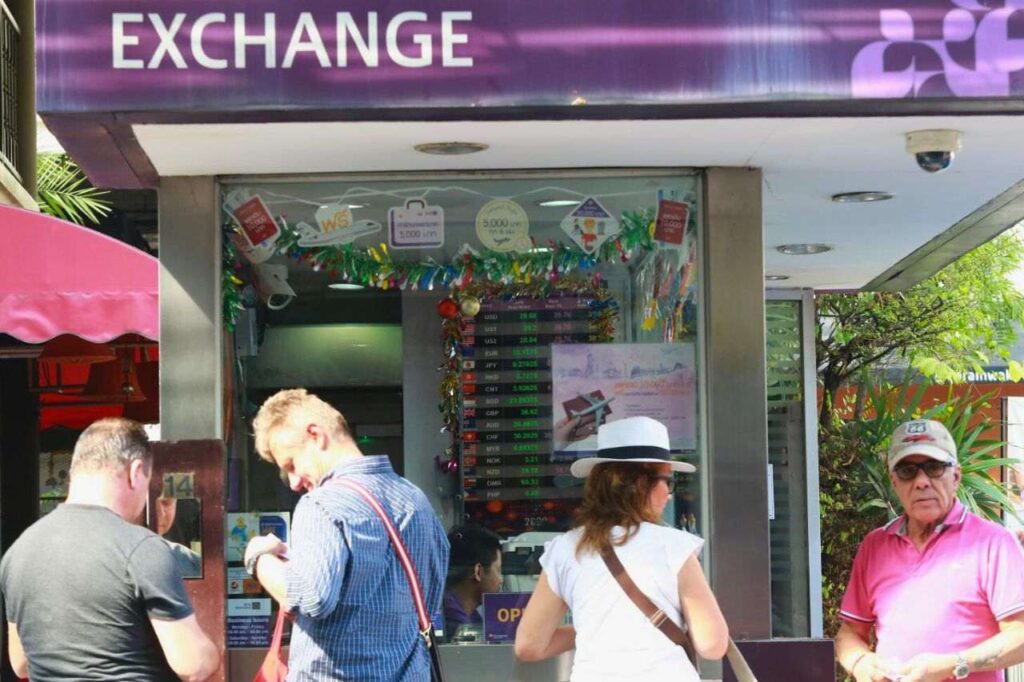
Tourists queue at a currency exchange counter. Photo: Bangkok Post.
If the high tourist season generally supports the baht, these flows "should not be as significant" this time, said Andy Ji, strategist at InTouch Capital Markets in Singapore.
If the Bank of Thailand (BoT) adopts a more accommodative stance and the government implements a tax on gold trading, the baht could slide to 33 to 1 US dollar, even if the greenback remains weak, he added.
A more moderate recovery could provide some respite for policymakers after the baht's rise of more than 4.5% this year has already undermined export competitiveness.
Struggling exports amplify the pressure on the baht
Containers in a port of Thailand.
Exports are under additional pressure due to the rise in US tariffs.
The strength of the currency has also made Thailand more expensive for visitors, which weighs on tourism.
See: Thailand alert: strong baht threatens tourism and exports
Along with exports, these sectors account for around 70% of the economy.
The slowdown in Chinese tourism is changing the game

Chinese tourists in Pattaya. Photo: South China Morning Post
Foreign tourist arrivals are expected to decline by around 6% this year, according to the Thai National Tourism Office, which would be the first annual decline in ten years outside of the pandemic.
This decline reflects weak demand in key markets like China, where security concerns and the baht's strength have dampened travel.
See: Thailand: Chinese tourism in free fall, how to revive it?
“The appreciation of the currency has reduced exporters' income and eroded their competitiveness,” said Apichit Prasoprat, Vice President of the Thai Industrial Federation (FTI).
“It also hurts tourism.”
The Bank of Thailand is ready to intervene to curb the baht.
Bank of Thailand. Photo: Money and Banking Online
According to data compiled by Bloomberg, markets expect at least one more rate cut in the next six months, following an easing cycle that has led to a 100 basis point decline since last October.
The central bank will maintain an accommodative monetary policy throughout next year due to the country's weak economy and the risk of new global shocks, Deputy Governor Piti Disyatat said earlier this month.
On Wednesday, October 8, 2025, the Monetary Policy Committee (MPC) of the BoT voted to maintain the policy rate at 1.5%.
See: The Bank of Thailand maintains its key interest rate at 1.5%
However, the baht could strengthen if:
- Growth is rebounding
- Tensions between the US and China are easing
- The dollar weakens following the rate cut by the US Federal Reserve
- Gold prices remain close to their record levels
Nomura expects it to appreciate to around 31.3 per dollar by the end of the year
For now, analysts believe that the authorities are likely to intervene to curb excessive gains.
Seasonal factors should support the baht, said Poon Panichpibool, a strategist at Krung Thai Bank.
“But if the baht is exceptionally strong relative to the currencies of its trading partners, the Bank of Thailand may intervene.”
- The baht is expected to appreciate by only about 1% by the end of 2025, half the historical average.
- The decline in tourism, particularly Chinese, limits foreign exchange inflows.
- Exports and accommodative monetary policy are also slowing down the baht.
See also:
Flying to Thailand will cost more: alert on a risk for tourism
Traveling to Thailand will cost more: the 300 baht tax is coming
Thailand faces a dilemma: gold makes the baht soar, tourism takes a hit
Thailand: a strong baht and regional competition are driving tourists away
Thailand: the rise of the baht linked to gold exports to Cambodia
Source: Bangkok Post
Prepare your trip to Thailand
Book bus, train, or boat in Thailand
Manage your money while traveling with Wise
If our news, tourist information, or cultural content has been useful to you and you'd like to thank us:
You can follow us on:
Twitter, LinkedIn, Facebook, Google News
Or install our app:
Install the Toute la Thaïlande app on your smartphone
⚠️ Cryptocurrencies involve risks: Invest only what you are willing to lose.

5 comments
We always come back to the same conclusions and the same attitude of the Bank of Thailand…
So I'll summarize in one single reflection: a strong baht, which is between 36 and 38/1 euro, hurts exports and commercial transactions that result from it, hurts international tourism which sees foreign tourists turn away from more expensive vacations in Thailand than in other tourist destinations in Southeast Asia, and also hurts, by ricochet, the national economy, the domestic GDP and the purchasing power of Thais.
But as the Central Bank has no desire to significantly lower its key rate to bring the baht back to an exchange rate between 38 and 40 baht/1 euro, nothing will fundamentally change by the end of the year, tourist season or not…
Besides, can we talk, at the end of 2025, about a 'high' tourist season?
I fear that the statistics for the last quarter and January 2026 will be the worst since the post-covid era, largely due to the strength of the baht that the Bank of Thailand has refused to devalue since 2022, to regain the competitiveness that was its strength in the decades before covid, when foreign tourists could get 40, 42 or 44 baht for 1 euro and exports were constantly increasing for a healthy economy and Thai GDP in great shape, while limiting imports and external dependencies through a policy of self-sufficiency successfully promoted by the late King Bhumibol !!!
Not complicated to understand anyway !!!
You have to look at the collapse of Western countries
It's happening every day, here, in England, in the US, Germany is not doing great.
Business bankruptcies, tax increases and many other joys that will arrive in 2026
They can do what they want with their currency, I doubt people will continue to travel in the same way from now on and in the years to come.
Hello,
Indeed, focusing on the baht exchange rate is not seeing that major currencies are depreciating sharply
In reality, the baht is holding up against the falling tide.
Thinking that the Bank of Thailand can act to lower its currency is like imagining that the tail wags the dog
Dear Hansson
Tourists will not specifically avoid Thailand because the currency is strong…
On the other hand, a strong currency obviously has an impact on tourist spending, who will naturally make their vacation budget in their reference currency and therefore spend less.
This is what we are currently observing.
As for this story of rate cuts, it has no tangible effect on the currency.
It's not because a central bank cuts rates that the currency plummets.
Look at the euro/dollar this year.
US rates are higher and yet the euro is appreciating.
Thai economic actors have only one option: to lower their prices… it's more effective than trying to play on the exchange rate.
Dear Parditi, hello…
Your analysis effectively reflects a rather worrying aspect of global economic health…
By governing and spending on credit, the "great" economic nations of the planet accumulate and increase their public debt year after year, and the pitcher goes to the well until it breaks!
No need to look at our neighbors, just look at the situation in France!
And you are obviously right when you say that the Thai exchange rate cannot alone solve the Kingdom's economic and tourism problems.
So lower the retail prices of services and commercial actors as a whole to encourage a new enthusiasm for disillusioned tourists who are themselves impoverished by the situation in their own country?
Yes, of course, it's a clue and maybe the only current one that the Thai government and central bank would subscribe to without hesitation…
Unfortunately, competition is already driving prices down, and given the narrow profit margins that commercial actors currently have, whether it's airlines, hotels, various tourist services agencies, and other restaurants, bars, and entertainment venues, and which only make up a few "%" of their turnover, once taxes, VAT, and other taxes are deducted, I unfortunately doubt that it will be possible for businesses related to international tourism to lower their prices further.
Effective, certainly, but economically possible, I'm less sure. The future looks very dark for many citizens, whether they are European, American or Asian…