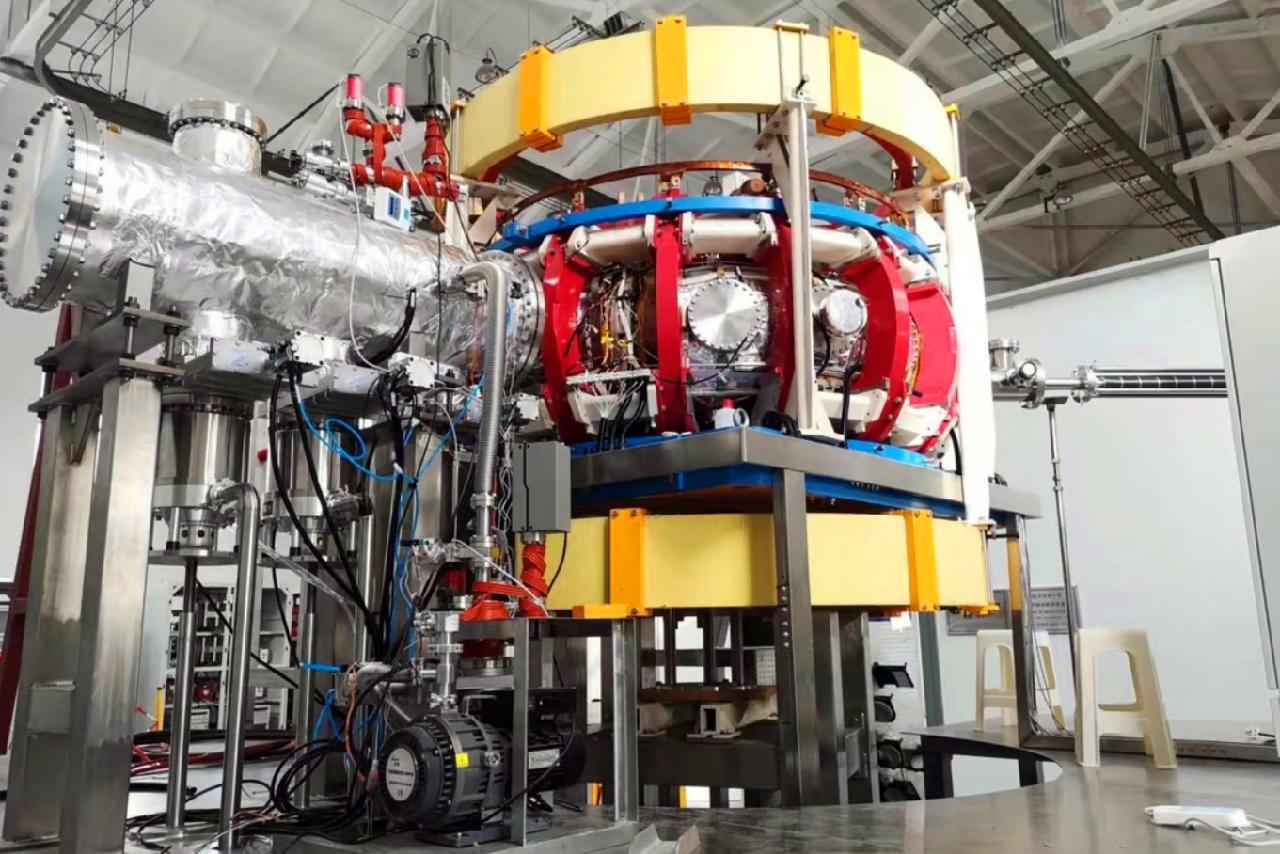
Thailand is venturing into nuclear fusion technology with Tokamak I, an experimental machine provided by China.
The Thai Prime Minister, Prayut Chan-o-cha, expressed satisfaction with the progress of Tokamak I (TT-1) nuclear fusion technology, highlighting its importance for achieving sustainable energy goals.
The 69-year-old Prime Minister's comments were made during a presentation on the development of nuclear fusion energy in Thailand by Anek Laothamatas, Minister of Higher Education, Science, Research and Innovation (MHESI), and Associate Professor Thawatchai Onjun, Executive Director of the Thailand Nuclear Technology Institute (TINT).
The government spokesperson, Anucha Burapachaisri, revealed that TT-1 is located in Nakhon Nayok Province and was offered by the Institute of Plasma Physics of the Chinese Academy of Sciences (ASIPP) to HRH Princess Maha Chakri Sirindhorn.
Thailand thus becomes the first Southeast Asian country to possess a tokamak.
According to TINT, the TT-1 operates by generating heat from nuclear fusion reactions, similar to those that occur in the Sun.
The device can produce heat up to 100,000 °C and will have the potential to reach one million degrees Celsius in the future.
Anucha Burapachaisri stated that the tokamak will contribute to the development of sustainable energy sources in the country and could be applied to various sectors, including industry, agriculture, and medicine.
The Prime Minister expressed his gratitude to all parties concerned, such as TINT, the Synchrotron Radiation Research Institute and the Thai Electricity Generating Authority, for their collaboration in creating a stable energy source and advancing science and technology to improve the nation's competitiveness.
He also stressed the importance of training qualified personnel in the field of fusion technologies and strengthening Thailand's capabilities in science and engineering.
He stressed that TT-1 was an alternative energy source to address climate concerns, as it generates clean and environmentally friendly energy without emitting greenhouse gases.
TINT installed TT-1 in February and successfully tested the system on April 21, marking an important milestone in its full operation next month.
In the next decade, TINT intends to build Thailand's first internal device, positioning the country as a fusion technology development center, according to Anucha Burapachaisri.
Source: Bangkok Post
Prepare your trip to Thailand
Book bus, train, or boat in Thailand
Manage your money while traveling with Wise
If our news, tourist information, or cultural content has been useful to you and you'd like to thank us:
You can follow us on:
Twitter, LinkedIn, Facebook, Google News
Or install our app:
Install the Toute la Thaïlande app on your smartphone

2 comments
Thailand now has the technology to recreate the equivalent of the nuclear fusion reaction that allows the sun to provide our planet with certain essential elements for our biological survival…
However, we are obviously very far from being able to recreate this fusion at an energy level such that it would be exploitable to replace nuclear fission (used since always in nuclear power plants): this reaction, which consists in merging 2 hydrogen nuclei to give birth to a heavy helium nucleus, is done on a 'Lilliputian' scale, because it requires an enormous energy consumption before reaching the stage where the amount of energy produced exceeds that consumed... and this only lasts a few seconds, because the induced heat reaches hundreds of thousands of degrees (15 million degrees with regard to nuclear fusion reactions at the core of our sun).
We are therefore far from "producing" this energy which self-feeds in a controlled closed circuit and even less from imagining at the present time (and probably still for decades) the way to channel this energy and tame it so as to be able to use it for all the energy needs of the inhabitants of planet Earth…
Let us therefore return to our good old nuclear fission energy which still has a bright future ahead of it, with its advantages and disadvantages known for decades, and let the few Thai researchers who are launching into these experiments remain in their bubble and their very closed specialized circle.
Currently, the exploitation of nuclear fusion as a universal replacement energy available to everyone remains in the realm of science fiction. And this "gift" offered by China was certainly not made free of charge..
What does China expect from Thailand in return for this very "reactive" gift!
Fusion is not for tomorrow.
Until then, we have stocks for fission for at least 500 years with fast neutron technology, self-stabilizing in fluorine salts.
Why don't the Chinese offer this Sino-American technology to the Thais?