
The Thai army has presented its clashes with Cambodia as also being a fight against cybercrime networks.
Describing these strikes as a ‘war against the army of scammers’, a military division involved in the border conflict said this week that it is on the front lines against the global threat posed by transnational crime syndicates.
These networks operate mainly from Thailand's neighboring countries, particularly Cambodia, Laos, and Myanmar.
Reminder: Cambodia at the heart of global cybercrime accusations

Cambodian flag and call center. Illustration: The Nation Thailand
A report by the United Nations Office on Drugs and Crime (UNODC) accused Cambodia of being one of the largest bases of cybercrime in the world.
See: Thailand wants to mobilize the world against Cambodian cybercriminals
According to the report, fraudulent call centers contribute between 40 and 60% of Cambodia's gross domestic product and are supported by the ruling elite.
See: Fraudulent call centers: Thailand accuses Cambodian elite
On May 1, 2025, FinCEN, a US Treasury bureau, proposed cutting off Cambodian group Huione's access to the US financial system for its alleged role in laundering funds linked to cyberattacks and online scams.
Huione's director is Hun To, the cousin of current Cambodian Prime Minister Hun Manet and the nephew of his father, former Prime Minister Hun Sen.
See: Call centers in Cambodia: the noose tightens around Hun Sen's family
Regional observers and analysts noted that the recent conflict, which began on May 28, was well-timed for the Hun family to divert attention from their call centers.
See: Cambodia provokes Thailand to protect its scam centers
A conflict over two crises with Cambodia

A bridge and a Cambodian mortar position were hit by Thai artillery fire near Ban Nong Chan, in Sa Kaeo Province, on Friday, December 12, 2025. Photo: Thai Army Military Forces
Thailand's new rhetoric brings together two latent crises in Southeast Asia:
- The border war between neighbors that has killed dozens and displaced half a million people
- A vast ecosystem of scams that has enabled the diversion of billions of dollars, mainly in what are called "scam camps"
This framework also shows that Bangkok is seeking to align itself with both Washington and Beijing, who have each pushed Southeast Asian countries to crack down on scam operations.
In two statements released this week, the second Thai regional military command, which is in charge of operations in four of the seven border provinces, said:
« Some of the targets hit by the Thai army in Cambodia in December were complexes used by Cambodian troops to carry out their fraudulent activities. »
Previously, it focused only on military targets.
Thailand has "cut off logistical and operational supply lines" and "dismantled transnational criminal support structures", the command said in a statement released on December 17.
"The real adversary is transnational criminal networks and power structures that support illegal interests through violence."
In a separate statement released on December 18, the command said Thai forces had neutralized at least six facilities linked to scamming activities.
It said these sites, described as casinos, included two establishments already sanctioned by the US government.
US President Donald Trump took an interest in the border conflict between Southeast Asian neighbors, threatening both countries with trade restrictions in July to end the fighting, then oversaw a peace agreement in October.
Mr. Trump said the two leaders had committed to ending the fighting after meeting with them last week.
But Thai statements this week suggest that the US administration has given Bangkok tacit approval to continue its strikes.
“This explains why many countries, although they have called for a ‘ceasefire’, have taken no concrete action against Thailand, including the United States, which seemed to be showing polite caution as supporters of peace,” the army unit said.
The White House did not immediately respond to a request for comment outside normal office hours.
Thailand has deployed F-16 and Gripen fighter jets to bomb buildings and bridges used by the Cambodian army since the border conflict resumed on December 7.
Thailand stated that these targets included 'abandoned' casinos that housed drone command centers, weapons depots, or troops and elite snipers.
On December 18, the Cambodian Ministry of Defense stated that Thailand had used F-16s to drop two bombs on Poipet, a casino town known to harbor cybercrime operations.
It did not specify whether casinos had been hit.
These casinos are also accused of laundering money from Cambodian fraudulent call centers.
The Thai Air Force stated that it was targeting rocket depots.
Responding to a question about whether Thailand was specifically targeting Cambodian casinos, the deputy spokesperson for the Royal Thai Army, Richa Suksuwanan, said at a press conference on December 18:
"The attacks did not solely target casinos and scammers.
All identified targets were clearly used as military bases, often including drone command centers and weapons depots."
Since the beginning of 2025, Thailand has intensified its crackdown on scam networks operating from its Southeast Asian neighbors, a move publicly supported by Chinese President Xi Jinping.
The Hun Sen–Paetongtarn affair, a political and diplomatic turning point
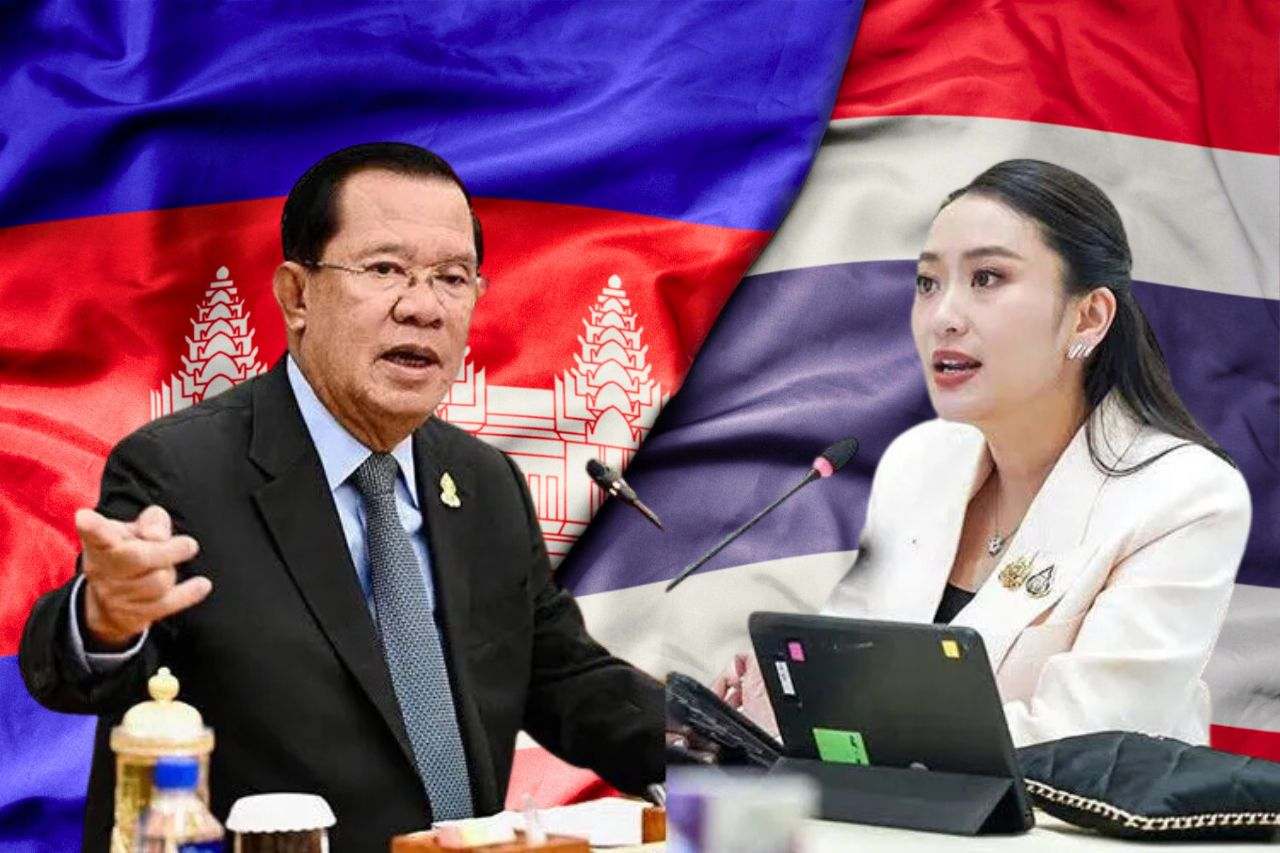
Hun Sen, President of the Cambodian Senate, and Thai Prime Minister Paetongtarn Shinawatra.
The kingdom initially focused its fight against scam networks established in Burma, avoiding targeting Cambodia at first to preserve diplomatic relations.
However, after Hun Sen disclosed a private exchange with former Prime Minister Paetongtarn Shinawatra in June 2025, Bangkok expanded its campaign to call centers operating from Cambodia.
Paetongtarn sought to defuse tensions with a direct appeal to the former Cambodian leader, whom she called "uncle," citing the Thai army as a common adversary in a context marked by her family's conflicted history with the military.
The recording and publication of this private conversation by Hun Sen, who visibly did not seem to want to end the tensions, triggered a major political crisis in Thailand, leading to the dismissal of the Prime Minister.
Human trafficking and violence in scam centers

Photo taken from a video showing a man jumping from a tower housing a call center in Cambodia. Suicide is sometimes the last resort for prisoners in these centers who want to escape torture.
Cyber scam operations, which represent billions of dollars, have been developing in the region for years and are often carried out by Chinese nationals who fled in 2020 following a national crackdown.
According to a United Nations report, criminals have smuggled hundreds of thousands of victims from 56 countries of origin to work in scam complexes.
Some are voluntary, while others have been kidnapped and are tortured, or even killed when they fail to meet the high financial targets demanded.
See: Cambodia: Atrocious death of a Thai tortured in a call center
In November, Thailand handed over to Cambodian authorities a naturalized Cambodian citizen of Chinese origin, suspected of being a casino kingpin and wanted by Beijing.
In February, Thai authorities repatriated several Chinese nationals who had worked in fraudulent operations in Myanmar.
Regional pressure and economic measures against the illicit economy
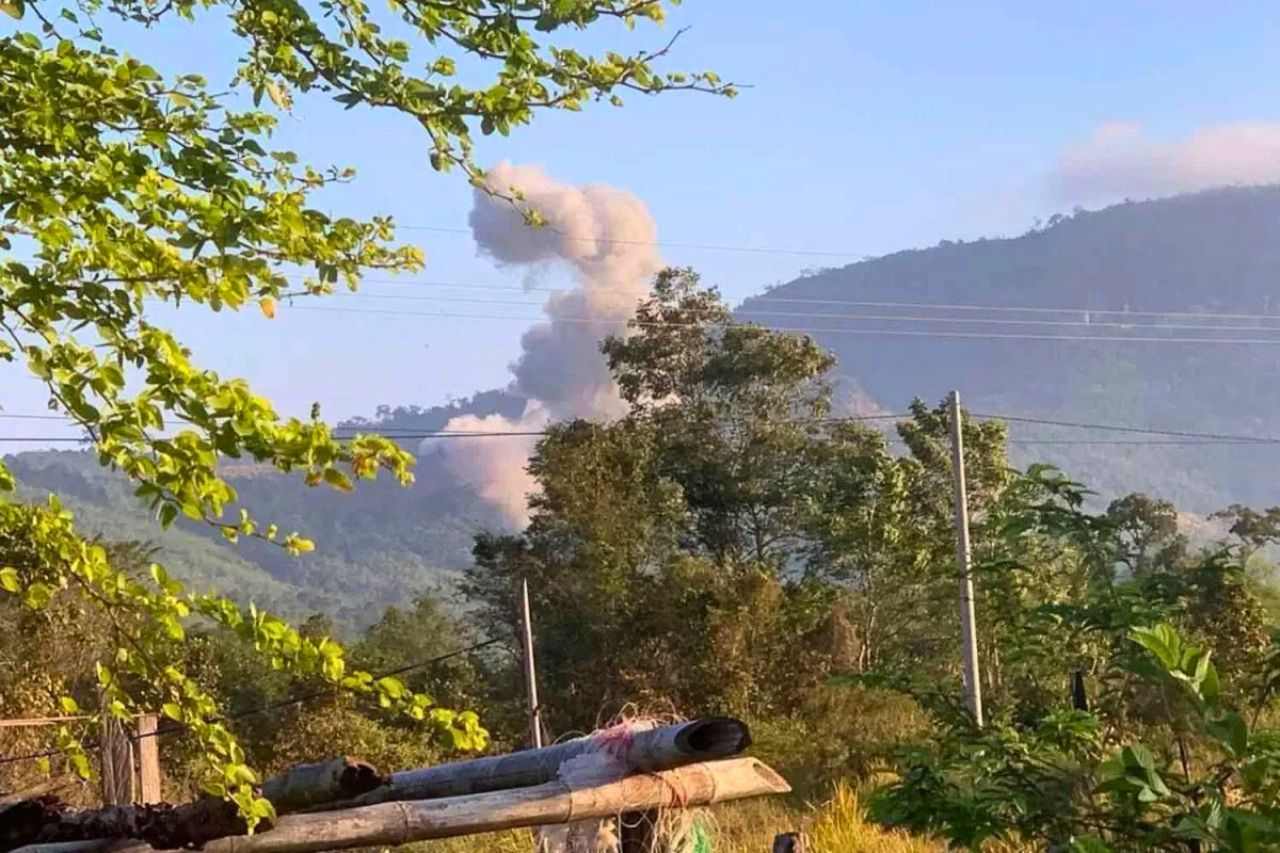
A Thai F-16 fighter jet bombed and destroyed a casino in the Chong An Ma district after the Thai army discovered that the establishment was serving as a base for the Cambodian army and a hideout for heavy weapons. Photo: Thai Armed Forces
The measures taken by the Thai army against Cambodian casinos follow a series of measures taken earlier in 2025 to combat the illicit economy.
Thailand has also suspended its exports of goods to Cambodia, particularly fuel, which it claims would be used to facilitate transnational criminal activities, and has banned Thais from traveling to Poipet to work.
These measures follow similar efforts when Thailand cut off electricity, Internet access, and fuel supplies in certain regions of Myanmar suspected of harboring cyber scam operations.
Thailand and Cambodia have also jointly dismantled a scam center in Poipet, where hundreds of foreign workers were being held captive.
On the other hand, other operations have only resulted in the discovery of empty call centers, suggesting that those responsible had been alerted in advance.
The Thai military said that during the visit of Chinese Vice Minister of Public Security, Liu Zhongyi, to Bangkok on December 17, the Chinese authorities expressed their concerns.
According to Bangkok, Beijing believes that the Cambodian government maintains "common links and interests" with certain fraudulent operations.
The government of Hun Manet in Phnom Penh denied the existence of such relations.
On December 18, China sent an envoy to Cambodia and Thailand to mediate.
- The Thai military now presents the conflict with Cambodia also as a fight against cybercrime networks.
- Bangkok claims to have targeted facilities linked to scams, including casinos accused of money laundering.
- According to the UN and several reports, Cambodia has become a major regional hub for fraudulent call centers.
- The political crisis triggered by the disclosure of a private exchange between Hun Sen and Paetongtarn Shinawatra marked a diplomatic turning point.
- The Thai crackdown on scams would benefit from the support of Washington and Beijing, despite calls for a ceasefire.
See also:
Traveling to Thailand despite the conflict with Cambodia: what you need to know
Thailand–Cambodia: fighting continues, no ceasefire
Thailand-Cambodia: ceasefire collapses, fighting resumes
Crackdown on cybercriminals in Cambodia and Myanmar
Horror of call centers in Cambodia: kidnapping, torture, rape
Source: The Straits Times
Prepare your trip to Thailand
Book bus, train, or boat in Thailand
Manage your money while traveling with Wise
If our news, tourist information, or cultural content has been useful to you and you'd like to thank us:
You can follow us on:
Twitter, LinkedIn, Facebook, Google News
Or install our app:
Install the Toute la Thaïlande app on your smartphone

5 comments
Beyond this military offensive targeting both military objectives and the organization of fraudulent call centers, I am curious to see the percentage of votes that Pheu Thai will garner in the upcoming February elections.
Far from having given up his influence on Thai political life and despite the criminal conviction he is currently serving, as well as the trials awaiting him in the near future, Taksin Shinawatra, lacking close descendants, has already installed his nephew Yodchanan Wongsawat, 42, at the head of the candidates for the post of Prime Minister, provided, of course, that Pheu Thai wins the legislative elections on February 8, 2026.
Never heard of Yodchanan Wongsawat in the Thai political landscape?
He is simply the son of former PM Somchai Wongsawat, himself married to Saowapha Shinawatra, who is none other than one of Thaksin's sisters…
Inexhaustible, the Shinawatra family!!!
Bury one, and three rise from the dead…
When I told you that the election campaign was going to be explosive! And it hasn't even officially started yet, the best is probably yet to come!
It reminds me of the Guignol theater in the Luxembourg Gardens in Paris: the policeman beats Guignol with his big club year after year, but Guignol always gets back up without a scratch!
We should target cyber scam centers with EMPs.
It would be very effective and wouldn't kill civilians...
Don't they have that in Thailand?
JEANMOULIN, hello…
I don't know if the Thai Army or the Thai Civil Engineering has this EMP technology, but even if it was possible to use this electromagnetic destruction technology, it would be, in my opinion (I'm not an expert in the field) necessary to control its use to limit it to the electrical and electronic infrastructures of call centers and IT logistics related to these centers, without damaging civilian electricity networks and management of the computer energy supply to the Cambodian population, to target only those responsible and not to make innocent victims and civilian infrastructure, deprived of electricity, IT, transport, etc., such as hospitals for example, emergency services, and businesses providing services to the population.
And that, I am not certain that Thailand can act effectively from its national territory without inevitable collateral damage, even on Thai territory, as it is possible to do so in a close and very targeted manner against invading drones.
It would be necessary to have the opinion of experts and engineers in computer science and electromagnetism, but I suppose that if it were possible to act in a targeted manner at a long distance against these call centers, this would require control capabilities of high-definition technologies, such as those capable, from Earth, of reaching, disrupting and potentially destroying spy satellites for military use, and this, I do not believe that Thailand is capable of, nor can it assume the cost and maintenance, nor master its use…
It is the civilian population that is paying a heavy price for this ongoing conflict, which is allowing the Bangkok government to mask its inability to lead the country, which is aspiring to more democracy, while awaiting the February elections…
The human cost of this war is terrible, especially for Cambodia, it's sad for all these innocent victims killed to protect Hun Sen's call centers.
They hide the number of Cambodian soldiers killed, as during the last clashes to save face, but the numbers must be very high.
Hun Sen's objective must have been to continue provoking attacks, laying mines and then calling for peace to keep the conflict in the foreground of business with call centers, and then starting again.
But Thailand, tired of these underhand attacks and lies, has decided otherwise.
This recalls what led to the war with Vietnam.
It was the Vietnamese Viet Cong who led the fighting to bring down the Lon Nol regime set up by the Americans after the massacre of Cambodian civilians during the terrible American "Menu operation".
Then the Khmer Rouge took power and in return for their gratitude, they killed the Vietnamese military advisers who had remained with them and allied themselves with the USA.
They then launched numerous attacks against Vietnamese cities.
Aware that they were no match for the Vietnamese army, they would arrive in cities, massacre as many civilians as they could, and then return to hide in Cambodia before having to face the Vietnamese army.
This is what led to the invasion of Cambodia by Vietnam.
Hun Sen, a former Khmer Rouge, uses the same sneaky techniques on a smaller scale, fortunately, and is now getting the slap he deserves, which unfortunately kills many innocent people.
If only the Cambodians could understand that the enemy is not Thailand but Hun Sen and his family!