
The popular resort town of Pattaya in eastern Thailand is seeking to shake off its reputation as a hub for sex tourism.
Pattaya 's tourism operators are committed to promoting family tourism, local cuisine and Thai martial arts.
They want to eliminate the image of the capital of sex tourism that it has long had.
They also urged authorities to respond to the increase in the number of tourists following the state's efforts to allow travelers from more countries to stay in the kingdom for up to 60 days.
See: You can stay 60 days in Thailand without a visa from June 1
The Association of Chonburi Tourism Federation (ACTF) held a tourism workshop this week bringing together major operators from Pattaya and Chon Buri, as well as tourism operators from five major foreign markets:
Germany, Russia and the Commonwealth of Independent States (CIS), China, South Korea and India.
Thanet Supornsahasrungsi, president of ACTF, said most tourism operators agreed that Pattaya's nightlife image remained dominant among foreigners, more so than any other tourist attraction.
He said there was a need to promote new family-oriented activities to keep up with independent tourism trends.
Mr Thanet said the town still had strong growth potential thanks to its various attractions.
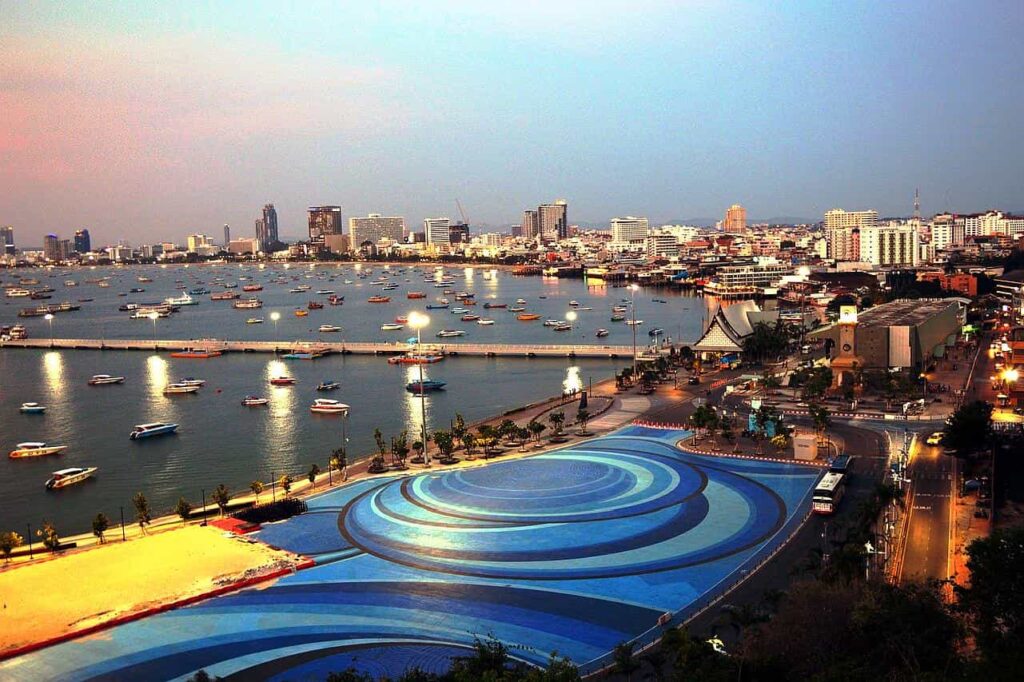
View of Pattaya. Photo: Victoria Watercolor
These include water parks, world-class golf courses, Muay Thai camps , and local communities known for their crafts in outlying areas.
See: Things to see and do in Pattaya, all the activities not to be missed!
Chon Buri's local cuisine is expected to be featured in the 2025 Thai Michelin Guide.
He said that in the past, Pattaya attracted a large number of retired foreigners who frequented nightclubs and were into sex tourism.
However, the average age of tourists today is younger and they are looking for varied experiences, like Russian tourists traveling with children, Mr. Thanet said.
“There is no denying that some tourists still want to experience nightlife, and authorities should regulate an area for these businesses, by zoning bars, clubs and motels for adults in one place, as can be seen on Bangla Road in Phuket,” he said.
“As market trends change, all businesses in Chon Buri, including bars and nightclubs, must adapt to survive.”
Other key issues raised at the meeting included traffic congestion, lack of transportation and flood prevention.
The government announced this week that it is allowing nationals of 93 countries to travel to Thailand without a visa for up to 60 days.
Mr. Thanet said the tourism sector is expected to benefit from the move, highlighting plans for direct charter flights from Kazakhstan to U-tapao Airport starting next month, which were arranged after the administration finalized the visa waiver program for that country.
With the expansion starting soon, he said all relevant authorities should be prepared to handle an influx of tourists.
See: Overtourism: Thailand must take a long-term view
"Our problem is that not every authority has been integrated," Mr. Thanet said.
For example, when there is a traffic problem in Pattaya City, city officials may refuse to act, claiming that it is the responsibility of the police.
Mr Thanet said that without proper management, large numbers of tourists could lead to an increase in accidents or crime rates.
See: Visa exemptions in Thailand: between advantages, overtourism and illegal work
He added that the government must also assess eligible countries to determine whether they pose a risk of visa overstays or illegal work in Thailand, while immigration rules must be strictly enforced for visitors.
See also:
Two foreign tourists die in a fall at Pattaya in Thailand
Lions spotted in the streets of Pattaya in Thailand: police confiscate the big cats
Increase in tourist aggression in Pattaya, Thailand
Ladyboy pickpockets continue to wreak havoc in Pattaya, in eastern Thailand
Source: Bangkok Post
Prepare your trip to Thailand
Book bus, train, or boat in Thailand
Manage your money while traveling with Wise
If our news, tourist information, or cultural content has been useful to you and you'd like to thank us:
You can follow us on:
Twitter, LinkedIn, Facebook, Google News
Or install our app:
Install the Toute la Thaïlande app on your smartphone

2 comments
And here we have the recurring discourse, repeated over and over again throughout elections and years by certain local and national political leaders, which comes up again regarding prostitution in Pattaya.
Between the electoral speech of Prayut Chan-O-Cha in 2023 which assured that he would definitively reduce prostitution in the city to nothing and the negationist speech of a high-ranking police officer of the Province of Chonburi who declared in a very serious tone that prostitution in Thailand being prohibited, it was clear that there were no prostitutes and prostitution in Pattaya, there is a reality which, well beyond the Thai borders, is very real, and this, since the world exists: prostitution and the sexual trade that some people make of their bodies has always had the last word, even in countries as closed and impervious to the issue as China and North Korea.
To return to Thailand and consider the situation in its reality (some will tell me, but where is the "problem"?), it seems that the abolitionist reactions of the oldest profession in the world is a problem more political than social, as assured by certain philosophers and scientists who advocate the usefulness of a prostitution recognized as being of public utility, which would allow according to them that numerous rapes and sexual assaults (there are already enough of them unfortunately) are avoided by thus serving as a sexual outlet for certain categories of people with a socially uncontrollable libido or sexual deviances that only prostitutes agree to satisfy for hard cash.
That said, and to analyze the specificity of prostitution in Pattaya (which according to the police does not exist, because they help themselves handsomely in passing, when, more or less discreetly depending on the methods used, certain police officers, under the cover of "spot checks" come behind the counter, to take delivery of their monthly envelope in exchange for their protection and leniency regarding the presence of "waitresses" very helpful to the customers), I like the reflection of one of the "cleaner" managers who proposes to build a "prostitution ghetto" to group together all the bars in the city (between 850 and 1,000 according to a recognized estimate), adding karaoke bars, massage parlors, "zone bars", peep shows and private clubs.
Given their number and that of the "sex workers" who perform there (between 15 and 30 in each establishment... do the math) it would be necessary to create a second "Pattaya" next to the existing one, because it would be necessary to place side by side all the bars which are currently located in a perimeter going from north to south, from Soi 2 to Soi 13/2, (4 km) add the entirety of Soi Buakhao, the bars of Beach Road, without forgetting of course Walking Street and all its adjacent alleys.
In short, this represents a rectangle approximately 4.5 km long and 2 km deep from the beach to 3rd Road, and according to an estimate on Google Map between 8 and 10 km², or 1000 hectares!!!
In other words: unrealizable...
Pattaya is what it is, just like the red light districts of all the major cities in the world, New York, Los Angeles, Manila, Rio, Amsterdam, Paris, Munich, Rome, Barcelona, Marseille, Bombay, Hanoi, Beijing, etc, etc, etc…
The Thai authorities would do better to focus on concrete objectives to improve the situation of sex workers, control prostitution free from corruption and forced labor, and fight against the debauchery of minors and pimping, offer sex workers recognized work, social security equivalent to any other profession and ensure, through non-corrupt police forces (there, I know I'm dreaming!), permanent and total security in the areas of the city that maintain a lively nightlife.
This would improve the overall situation of urban security at all levels, instead of chasing chimeras and goals that they will never achieve...
But it is also a way of sitting back and talking about goals that have no chance of being achieved, especially since they do not have the technical, human and financial resources to implement to achieve them: "You see, I wanted to do this, and that, and that... but no one followed me, no one helped me, that's why I didn't succeed, it's not my fault!!!"
Well, have a good day everyone….
It would also be good if Middle Eastern companies returned to Utapao like some did at the time, Emirates, Qatar, etc.