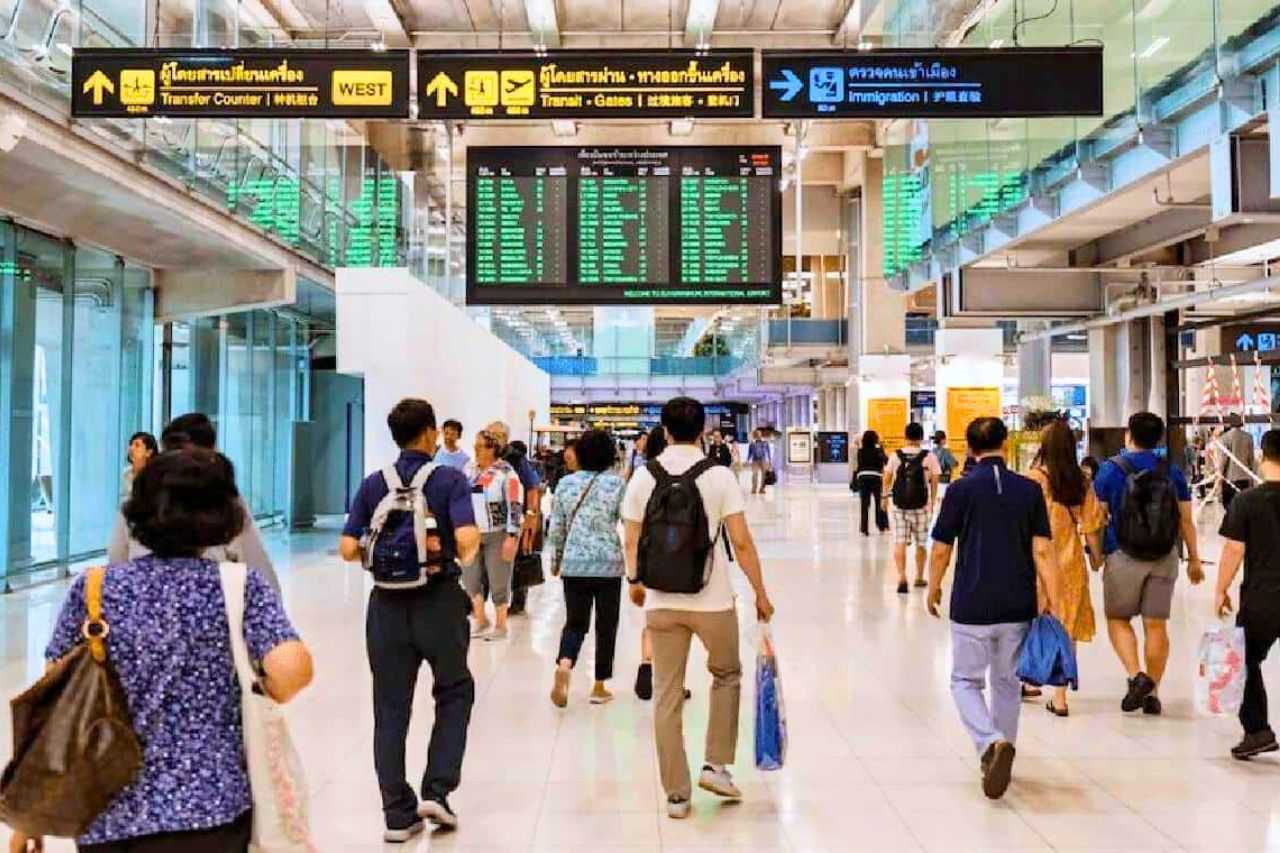
The Thai Travel Agents Association (ATTA) is optimistic for 2026 and expects up to 39 million foreign arrivals.
However, this goal could be weakened by a baht considered overvalued, which threatens the price competitiveness of the kingdom against its regional rivals, from Japan to Vietnam.
See: The baht is soaring: the Thai currency is approaching 30 to the dollar
Targeting 39 million tourists in 2026: ATTA's offensive bet

Tourists on a beach in Phuket. Photo: Bloomberg
The professional exhibition 'Tourism and MICE in Thailand: 2026 Outlook', scheduled for January 23, is expected to host between 1,200 and 1,500 Thai and foreign participants and generate at least 3 billion baht in revenue.
Its total budget is estimated at 10 million baht, half-funded by the Thai National Tourism Office (TAT), the Thai Convention and Exhibition Bureau and other partners.
According to Thanapol Cheewarattanaporn, president of ATTA, around 300 foreign buyers will participate in the event, including 100 from China.
TAT has organized familiarization trips to introduce them to new tourist products across the country.
Between 250 and 300 Thai tourism operators from major and secondary destinations will be present, including those from provinces affected by the border conflict between Thailand and Cambodia as well as severe flooding in the south.
Thanapol believes that several markets, including China, are recovering during this high season, following the official visit of the King and Queen and the increase in air capacity through new charter flights.
He expressed confidence in a rapid de-escalation of the conflict with Cambodia, due to its economic and tourism impact.
Tour operators hope that the meeting of the general border committee will yield fruitful results.
“This trade show must serve as a springboard to bring the Chinese market to 20,000 daily arrivals during the Chinese New Year, at the beginning of 2026,” he said.
For 2026, ATTA also plans several promotional tours in China as well as in other key markets.
Thailand will host several major international events in 2026.
Among them are the annual meeting of the IMF and the World Bank Group, Gastech 2026, the Global Wellness Summit 2026, and Amway China's meetings.
According to ATTA, these events are expected to increase business travel by around 20%.
"39 million arrivals is not an unrealistic target for 2026, if the tourism sector works proactively," said Thanapol.
Oncea new government is formed next year, ATTA hopes to strengthen its collaboration with the private sector to consolidate important markets.
The association is also calling for a rethink of promotions, for example by offering more significant discounts, eliminating certain entrance fees (natural parks, royal palace tickets) or subsidizing one night's stay in a 4- to 5-night package.
A too-strong baht threatens Thai tourism competitiveness
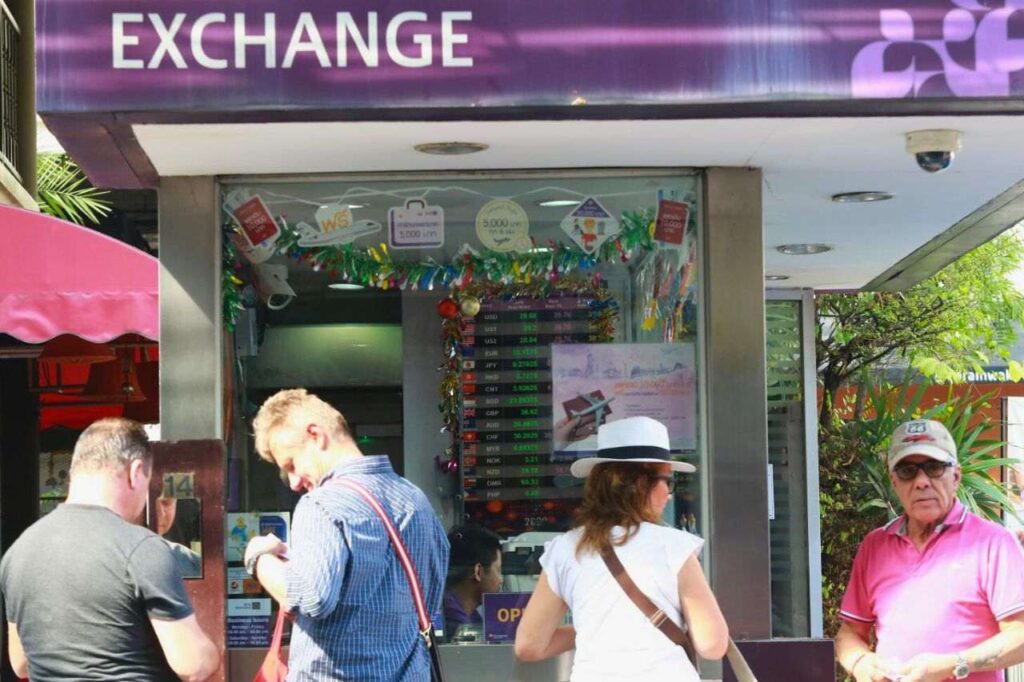
Tourists queue at a currency exchange counter. Photo: Bangkok Post.
Adit Chairattananont, Secretary-General of ATTA, warns that a "too strong" baht could harm Thailand's price competitiveness from the high season in late 2025 through 2026.
According to him, this would make travel and services in Thailand more expensive for foreign visitors than in competing destinations like Japan and Vietnam.
He warns in particular that if the baht appreciates beyond 30 to the US dollar, it could weigh on tourism for a long time.
He states that Thailand already has the highest cost of living in ASEAN and a stronger currency adds extra pressure as regional competition intensifies.
He cites Vietnam as a major competitor, with similar natural and environmental attractions but at a lower cost, and believes that the country can present itself as a more attractive destination, without facing the same tourism security issues.
Adit adds that when the baht appreciates while the Thai economy is not doing well, the problem worsens and tourism becomes more difficult to promote.
He believes that the most appropriate exchange rate would be 40 baht to the dollar, as after the 1997 Asian financial crisis, when the baht was stable and boosted exports and tourism.
In the current context, marked by a fragile budgetary situation, limited export growth, declining inbound tourism, and high household debt, he believes that an exchange rate adjustment is necessary.
According to him, a return to 35 baht per dollar would be required at a minimum, a level close to that observed in 2019, when group travel to Thailand was booming before the pandemic.
As an example, he recalls that Chinese tourists were able to exchange 1 yuan for around 5.4 baht last year.
Today, they only get around 4.4 baht per yuan, a drop of nearly 20%.
This loss of purchasing power is causing many travelers to prioritize cheaper destinations before considering a stay in Thailand.
« The Bank of Thailand should manage the baht at an appropriate level », said Adit, estimating that the currency may be driven by soaring gold prices, abnormal transactions or cryptocurrency-related flows that are difficult to control.
Chinese tourists: a fragile but real recovery

Group of Chinese tourists visiting the Grand Palace in Bangkok, Thailand. Photo: Xinhua/Wang Teng
Despite these concerns, ATTA expects Thailand to welcome nearly 9 million Chinese tourists in 2026, roughly double the 4.5 million expected this year.
See also: Thailand is banking on a strong return of Chinese tourists, +40% in 2026
This trend would help bring the total number of foreign arrivals to 39 million next year, up from an estimated 32 to 33 million in 2025.
Adit notes that following the official visit of the King and Queen to China in mid-November, online comments on Chinese social media were very positive, enhancing Thailand's image.
He also notes that the TAT participated in the CITM 2025 fair in Haikou, Hainan province, to strengthen ties and promote travel between Thailand and China.
Large organizations such as Amway have also shown their confidence in Thailand by organizing incentive trips bringing together a total of 13,000 participants, divided into 10 groups of 1,300 people each, between early March and early April 2026.
Adit acknowledges, however, that several incidents this year have destabilized Chinese tourists, notably the case of Chinese actor Xingxing, who went missing near the border between Thailand and Burma at the beginning of the year.
According to him, the impact was lasting and contributed to the loss of millions of Chinese visitors.
See: Thailand: cancellations or traveling with fear for Chinese tourists
He nevertheless claims that monitoring Chinese social media now shows almost no negative news about Thailand.
He also hopes that talks aimed at ending clashes on the border between Thailand and Cambodia will take place soon.
According to him, such a development would help improve the overall confidence of foreign travelers.
The TAT sees positive signs in the Chinese market

A group of Chinese tourists in front of the Grand Palace in Bangkok. Photo: Xinhua – Wang Teng.
Pattaraanong Na Chiangmai, executive director of the TAT's northern region, said the agency is starting to see positive signs after stepping up its marketing efforts on Thailand's safety image.
See: Tourist security: Thailand launches its "Seal of Trust"
Over the past two or three months, there has been little negative news affecting travelers' sentiment, which has prompted travel agencies to sell more packages, especially in second- and third-tier Chinese cities.
She added that Chinese arrivals in Thailand rebounded in December.
Although they are still down 28% from the previous year, the decline is less pronounced than between March and June, when they plummeted 41-48% after the Xingxing affair.
Currently, between 10,000 and 14,000 Chinese tourists visit Thailand every day, compared to a previous average of 8,000 to 9,000.
She also mentions the impact of tensions between China and Japan.
Chinese travel warnings advising against travel to Japan have prompted travelers to turn to other destinations offering similar products, mostly South Korea.
She expects the spillover effect to Thailand to be felt from next December.
According to her, the total number of Chinese arrivals for the whole of 2025 could even exceed that of Malaysian tourists and put China back in the first place.
She explains that the severe flooding in the south affected cross-border travel to the Hat Yai district, in Songkhla province, during the last month of the year.
Japan continues to massively attract Chinese tourists

Tourists in a street in Osaka, Japan. Photo: Nikada
Following the dispute between China and Japan, the latest figures from the Japan National Tourism Organization (JNTO) show that in November 2025, 562,000 Chinese tourists visited Japan, with a slowed growth of only 3% year-on-year, compared to 715,000 in October (+22.8%).
The cumulative number of Chinese visitors to Japan in the first 11 months of 2025 (January-November) amounts to 8.76 million, representing a 37.5% increase, making it the largest group of foreign visitors.
Next come South Koreans (8.48 million), Taiwanese (6.17 million), Americans (3.03 million), Hong Kongers (2.22 million), and Thais (1.06 million).
Conflict on the Cambodian border and air capacity: the two key variables for 2026

Thai civilians displaced due to the conflict with Cambodia. Photo: CTN News
Pattaraanong recalls that the TAT aims to return Chinese arrivals to 6.7 million in 2026, the same level as in 2024.
This target is considered achievable if negative factors subside and favorable factors strengthen.
Among the priorities: joint marketing with airlines to increase seat capacity on Thailand-China routes.
In 2024, the total capacity reached 8.81 million seats.
In 2025, it fell to 7.49 million, a decrease of 14%.
For 2026, demand for charter flights is expected to increase and the TAT is discussing additional incentive measures with Airports of Thailand (AOT).
She warns, however, that the border conflict between Thailand and Cambodia remains a major risk perception factor.
If the situation persists until mid-February 2026, the peak period around the Lunar New Year, it could further affect the Chinese market, especially in secondary cities that are more sensitive to anxiety.
She stresses that travelers from large cities understand better that the conflict zone is far from Bangkok.
She cites the example of last week: tour operators had to postpone the first three charter flights out of the 13 scheduled on the Haikou–Udon Thani route.
Flights were full, but after clashes broke out at the border, some tourists were misdirected due to the similarity between Udon Thani and Ubon Ratchathani, a province bordering Cambodia, causing delays in their travel plans.
Thailand thus approaches 2026 with high ambitions, driven by the goal of 39 million visitors and the prospect of a strong return from the Chinese market.
But between the persistent strength of the baht, increased regional competition, and geopolitical uncertainties at its borders, the recovery of tourism remains fragile and will largely depend on the authorities' ability to durably restore confidence and the kingdom's competitiveness.
- The ATTA expects up to 39 million foreign tourists in Thailand in 2026, including nearly 9 million Chinese visitors.
- The strength of the baht, close to 30 to the dollar, threatens the price competitiveness of the kingdom compared to Japan and Vietnam.
- Major international events and the resumption of charter flights could boost business travel by 20%.
- Confidence in the Chinese market remains fragile, particularly due to regional tensions and the border conflict with Cambodia.
- Air capacity between Thailand and China will be one of the key factors in tourist success in 2026.
See also:
Thailand: foreign tourist arrivals plummet by 7.25% in 2025
From tourist to resident, Thailand changes quietly
Thailand Visa: many tourists turned away, the vagueness of the rules worries
Thailand: hunting tourists by entering without a visa repeatedly
Thailand: the tourist tax is likely to be postponed again
Source: Bangkok Post, The Nation Thailand
Prepare your trip to Thailand
Book bus, train, or boat in Thailand
Manage your money while traveling with Wise
If our news, tourist information, or cultural content has been useful to you and you'd like to thank us:
You can follow us on:
Twitter, LinkedIn, Facebook, Google News
Or install our app:
Install the Toute la Thaïlande app on your smartphone
