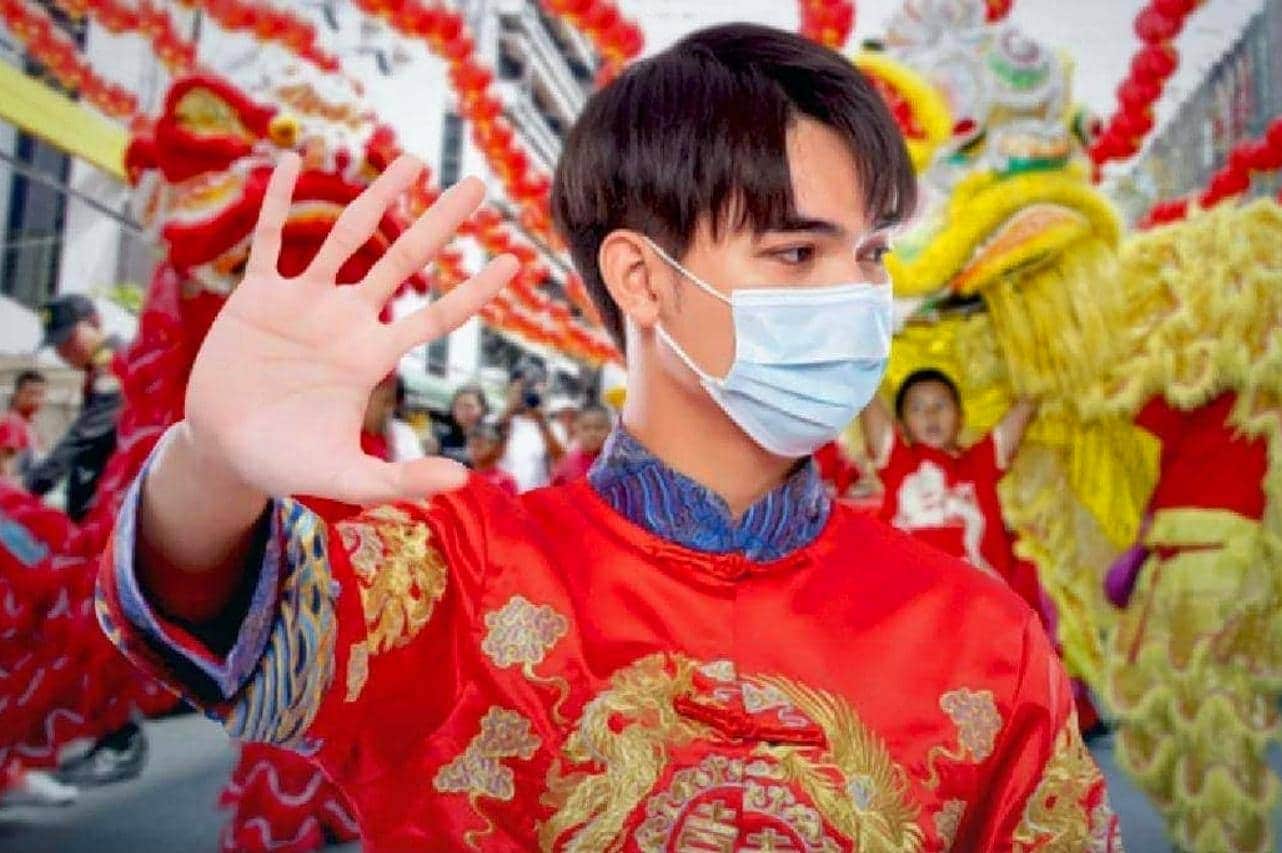
The upcoming return of Chinese tourists inspires as much hope as fear in Thailand as China faces a resurgence of Covid-19 cases.
There is also the fact that the tourism sector has not yet fully recovered from the pandemic, many hotels are closed and there is a lack of staff.
See: Overwhelmed by the number of tourists, Thailand is struggling with a labor shortage
An overload of tourists and a overwhelmed Thai healthcare system are concerns to watch out for next year after China's full reopening, with up to 500,000 tourists expected to start traveling during the Chinese New Year
Even though the tourism sector applauded Beijing's announcement of lifting most entry requirements from January 8, except for a pre-arrival Covid-19 test, tour operators are concerned about an imbalance between supply and demand.
See: China reopens its doors in January, Chinese tourists soon to return
The Governor of the Tourism Authority of Thailand (TAT), Yuthasak Supasorn, said that China's reopening would lead TAT to revise its foreign arrival target from 20 million to more than 25 million in 2023.
An influx of Chinese tourists, who have not been able to travel abroad for three years, could flock to Thailand during the Chinese New Year holidays at the end of January, with the possibility that 500,000 tourists arrive during this period and 3 to 5 million Chinese for the whole year, he said.
Mr. Yuthasak said that positive signs were noticed immediately, as 15 minutes after the announcement, the online travel platform Qunar, based in Beijing, saw searches for air tickets multiplied by seven, with Thailand being the most popular destination, followed by Japan and South Korea.
A recent survey had already revealed that Thailand, in the top 5 of the preferred destinations of the Chinese, was in 4th position of the countries that will be visited when China allows its nationals to travel.
See: Thailand risks experiencing a real tourist boom when the Chinese return
Tongcheng Travel's travel platform also reported an 850% increase in searches for international routes, mainly by users from Beijing, Shanghai, and Guangzhou.
Mr. Yuthasak said that the TAT and the private sector will meet today (December 28) to discuss preparations and assess the situation, as the major change in China's border policy after three years requires a recalibration.
He added that if the private sector has concerns about the Thai health system, the TAT will forward these issues to the Ministry of Public Health to ensure that the health system is ready.
"The most important factor is not how many Chinese will return to visit Thailand, but to help the country avoid another Covid wave and keep Thais safe," said Mr. Yuthasak.
Beijing has stopped announcing Covid infection figures this week after the country recorded more than a million daily cases, according to some media.
He said that the rebound of the Chinese tourism market could gradually help resolve the issue of overcapacity, as investors or operators will be ready to fully invest in employment and business expansion once this segment rebounds.
Sisdivachr Cheewarattanaporn, President of the Thai Travel Agents Association, said that increasing flight capacity should be Thailand's top priority.
In addition, Thailand must still monitor how Beijing contributes to facilitating the renewal of passports for its citizens, he said.
Mr. Sisdivachr said that China may also need to indicate which market it wants to promote for outbound tourism, as there is no update on lifting the ban on group travel for now.
“The end of quarantine is good news for China, especially for Thailand's small hotels, but the pace of recovery will be gradual and dependent on many factors,” said Marisa Sukosol Nunbhakdi, President of the Thai Hotel Association.
Ms. Marisa said that the limited number of flights to China will be an obstacle during the Chinese New Year on January 22, while the labor shortage for hotel operators remains as many workers have left the sector for other jobs.
She said that hotel operators need to be more active in recruiting staff and prepare to pay higher operating costs, both in terms of employment and electricity, due to increasing consumption.
Mrs. Marisa stated that even if Chinese tourists can contribute to generating revenue for various segments and destinations, such as those in the North, the tourism industry must learn not to be too dependent on a single market as it has happened in the past, when Chinese represented 25% of the global inbound market.
Risk of congestion at airports
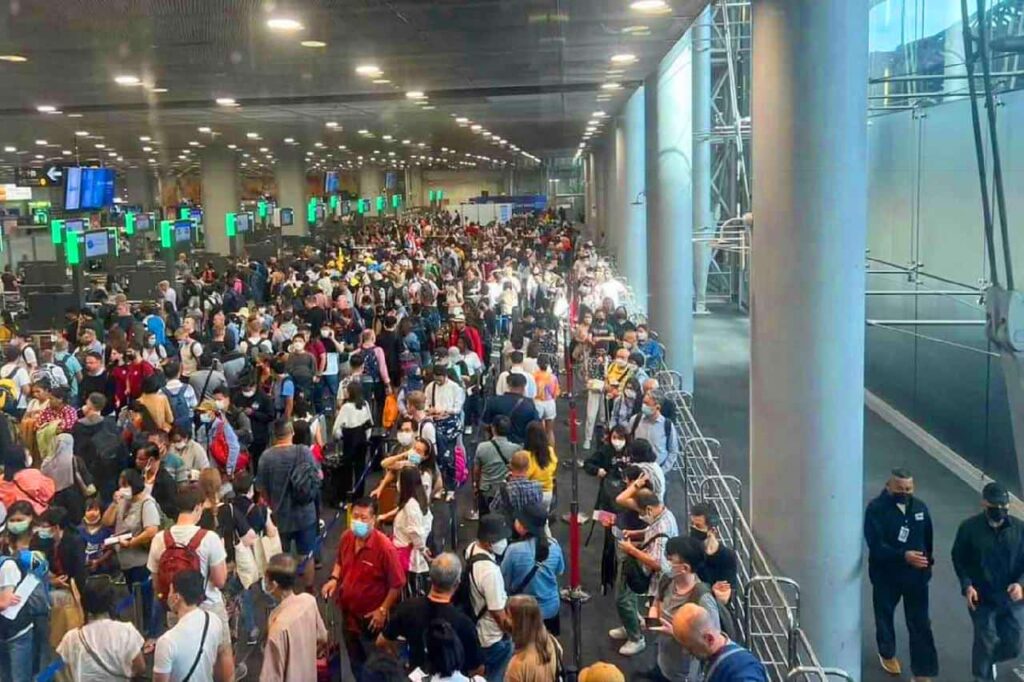
The arrivals hall at Suvarnabhumi Airport was crowded with passengers queuing on November 10, 2022. Photo Np Bow Facebook
Since the start of the high season, there have been several cases of congestion of travelers at Thai airports, the arrival of Chinese travelers risks amplifying this problem.
Tassapon Bijleveld, Executive President of Asia Aviation (AAV), said that congestion at Suvarnabhumi Airport generally occurs during peak hours, as most airlines are unable to increase the number of flights to meet growing demand.
He explained that most international flights were full to bursting, with a occupancy rate of more than 90%, higher than the average of 85% in normal times, which causes congestion at immigration and baggage claim when several flights land at the same time.
Mr. Tassapon added that the Airports of Thailand had already tried to solve this problem by increasing the staff, but that it was necessary to adopt a more serious approach if Chinese travelers returned en masse next year, because insufficient capacity for ground handling services also causes flight delays.
Nuntaporn Komonsittivate, Commercial Operations Manager of Thai Lion Air, said the airline could not commit to expanding its flights to the mainland in time for the Chinese New Year, as flight operations require at least one month's notice.
In addition, the airline should rotate the aircraft in its current fleet of 11 jets to operate night flights to China, as the airline awaits new aircraft, said Ms. Nuntaporn.
Santisuk Klongchaiya, Director General of Thai AirAsia, said that as soon as the Civil Aviation Administration of China officially allows international airlines to resume normal operations, the airline will immediately expand its services to the country, which could be in time for the Chinese New Year holidays.
Source : Bangkok Post
Notice to Adblock users
Toutelathailande.fr is an independent media outlet financed solely by advertising.
Automatic and intrusive video formats have been removed for several months to improve your reading comfort.
If our articles are useful to you, you can support the site by disabling your blocker for this domain.
Useful links to prepare your trip to Thailand
Book bus, train and boat in Thailand
Manage your money while traveling with Wise
You can follow us on:
Twitter, LinkedIn, Facebook, Google News
Or install our app:
All Thailand Application on your smartphone

3 comments
I don't see China allowing people to leave the country.
This is not the direction of the history wanted by Xi…
Since July 1st, 2022, Thailand's borders have been open to foreign tourists, while at the same time, the coronavirus epidemic and its multiple mutations were coming to an end all over the world…
Except in China, where the strict "zero covid" policy is still leading the country towards a resurgence of the disease with hundreds of thousands of new cases every day.
And since July 1st, no Covid alert has had to be put in place in Thailand, following the return of tourists of multiple nationalities, proof that it is not foreign tourists, often criticized during the health crisis in 2020 and 2021, who constitute so far a threat to the public health of the country.
Will it still be the same at the end of January and in the months that follow the probable arrival of tens or hundreds of thousands of Chinese tourists, eager to be able to leave their country after 2 and a half years of lockdown and travel bans in cascade?
It can indeed be strongly predicted, in view of the exponential increase in contaminations, officially declared 'out of control' by the authorities themselves, with insufficient sanitary equipment and overwhelmed and saturated hospitals, that among the Chinese tourists arriving in Thailand without being controlled at their departure from China, nor at their arrival in Thailand, some will be positive and contagious upon their arrival on Thai soil.
As the incubation period of the coronavirus is established between 5 and 12 days, it will be necessary to be vigilant and observe from January 20 and in the weeks and months that follow, if an abnormally high increase in new cases among the Thai population is recorded.
For it would be catastrophic if a new Covid wave were to decimate a return to international tourism, very fragile and which cannot afford the slightest negative slippage at the start of 2023.
It is unfortunate to regret that China is the only country in the world that allows its population to leave the territory without any control in the midst of a contamination crisis, without having the means to control it and effectively vaccinate its population, whereas until now, it literally 'locked up' its patients in care and confinement centers or at their homes for several months and by entire cities of several million inhabitants !!!
The law of "everything is forbidden" not working, we decree from one day to the next, to adopt that of "everything is allowed" by lowering all protective barriers, even the most elementary…
Personally, this peaceful invasion planned from January 8 does not bode well and I don't think I'm the only one to think so!!!!
This was just announced this Tuesday, December 28, via international press agencies: Japan, India, Malaysia and the United States have taken or will decide on special measures to control Chinese travelers arriving on their territory.
And it is likely that other countries will follow suit...
Do the political and tourism authorities in Thailand plan to do the same and not just see the economic side of the return of Chinese tourists, but also the need to control the arrival of a population in the midst of an exponential contamination wave?
Where will they take the risk of a new wave of national contamination via Chinese intermediaries, with a step back in terms of restrictive health measures that would be a catastrophe for Thailand?
The Chinese health authorities in Beijing have given up counting new cases and objectively informing the WHO about the evolution of contaminations as well as the probability of mutation of new variants (data on viral genomic sequences) since yesterday.
In short, China "gives up" and throws in the towel, declares itself "K.O" in its fight against Covid and chooses this moment to allow its population to leave the country for a vacation!
Already finger-pointed when in 2020, it was necessary to establish the Chinese origin and starting point in Wuhan of the global contamination, China could now organize a 2nd viral invasion, but with an uncovered face ! G-E-N-I-A-L !!!