
Despite the conflict with Cambodia, Thailand remains safe for travelers in 2026; only a few border areas are to be avoided.
Despite current military tensions with Cambodia, the vast majority of Thailand is completely unaffected by the conflict.
Bangkok, Chiang Mai, Phuket, Pattaya, Koh Samui and Krabi continue to operate normally and no security disruptions have been reported.
The fighting is strictly limited to remote border areas along the border between Thailand and Cambodia, hundreds of kilometers from major tourist destinations.
Here's what travelers need to know about the situation in January 2026 if they plan to travel to Thailand and surrounding areas during the conflict with Cambodia.
What's happening at the border?
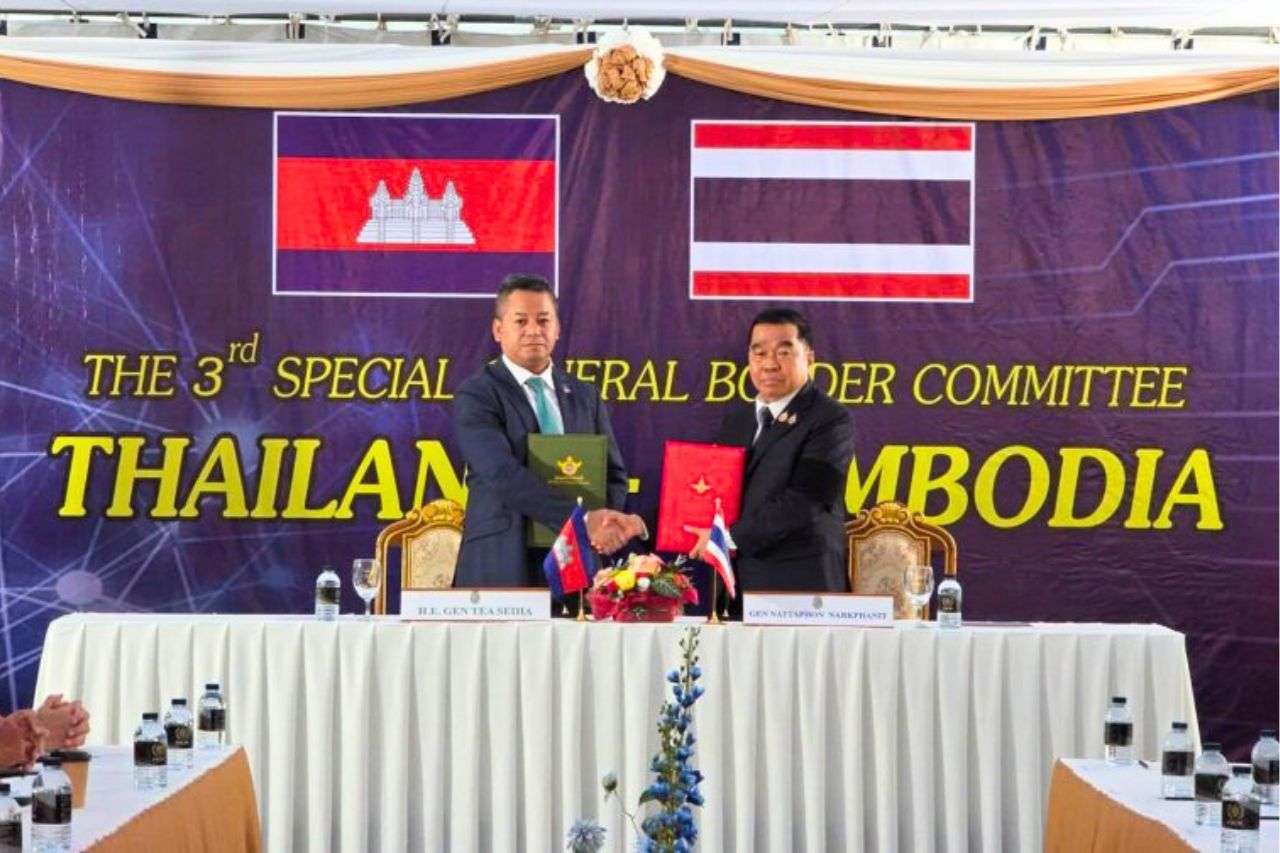
General Nattaphon Narkphanit, Thai Defense Minister, on the right, shakes hands with his Cambodian counterpart, General Tea Seiha, after signing a joint statement at a meeting of the Thai-Cambodian General Border Committee (GBC) at the permanent border post of Ban Phak Khat, in Chanthaburi Province, Thailand, on Saturday, December 27, 2025. Photo: Thai Army
A territorial conflict between Thailand and Cambodia escalated into armed clashes in mid-2025.
Fighting broke out in July 2025 (48 deaths, 300,000 displaced), then resumed in December 2025 (50 to 60 deaths, over 500,000 displaced).
A ceasefire came into effect on December 27, 2025, but it remains fragile, an incident reignited tensions on January 6, 2026, in Ubon Ratchathani, when a projectile injured a Thai soldier.
The Cambodian authorities refer to an accident, claiming that soldiers burned a pile of trash containing ammunition.
The conflict concerns disputed borders resulting from treaties dating back to the French colonial era (1904/1907).
However, according to several analysts and observers, the recent conflict appears to be an attempt by Cambodia to divert the current strong international attention to these cyber-fraud networks.
See: Cambodia provokes Thailand to protect its scam centers
With the Thai elections scheduled for February 8, the border issue has become politically sensitive, complicating peace efforts.
Specific areas to avoid
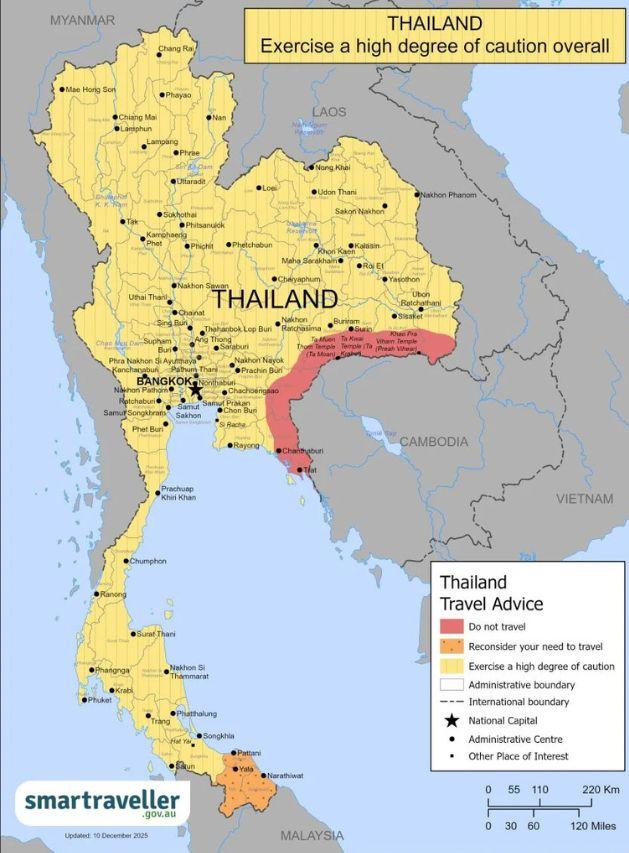
Border areas to avoid (in red) between Thailand and Cambodia.
International governments, including those of the United States, United Kingdom, and Australia, have issued "Do Not Travel" warnings for areas within 50 kilometers of the Thailand-Cambodia border in affected provinces.
This exclusion zone covers:
Border provinces to avoid
- Sa Kaeo (Aranyaprathet/Poipet border area)
- Buri Ram (southern border districts - Phanom Rung Historical Park closed)
- Si Sa Ket (Kantharalak district – Khao Phra Wihan/Preah Vihear temple closed)
- Surin (southern districts – Ta Muen Thom temple inaccessible)
- Ubon Ratchathani (eastern border areas, including the »Emerald Triangle»)
- Chanthaburi (border areas near Pailin, Cambodia)
- Trat (areas adjacent to Koh Kong Province, Cambodia)
These areas have been affected by artillery fire, rocket attacks, and heavy weapon exchanges.
Unexploded ordnance and recently laid landmines pose additional hazards.
Historic Khmer temples along the border, normally tourist attractions, are currently militarized and off-limits.
Land border crossings are closed
If you are planning a trip between the two countries, be aware that all border posts between Thailand and Cambodia have been closed since the end of June 2025 due to the conflict.
You will therefore have to take a flight, as land travel is currently not possible.
The issue of Koh Chang and Koh Kood

Koh Chang Island. Photo: Philip Roeland
The popular islands of Koh Chang, Koh Kood, and Koh Mak, located in Trat Province, Thailand, are technically within the 50 km alert zone but have experienced no violence.
Ferries are operating normally, hotels are open, and daily life continues without disruption.
The catch: travel insurance
As these islands are subject to government 'do not travel' advisories, standard insurance policies may not offer coverage.
Claims for reimbursement of medical or evacuation expenses could be rejected due to the alert status.
The islands have been caught up in the turmoil due to the political rhetoric surrounding MOU 44 (maritime resource development).
Despite nationalist claims, Koh Kood's sovereignty is not actually disputed, but tourism has collapsed, with a hotel occupancy rate of around 20%.
If you travel there: check that your insurance covers alert zones or take out specialized 'conflict zone' insurance.
The islands are physically safe; the risk is financial.
The main tourist destinations are not affected
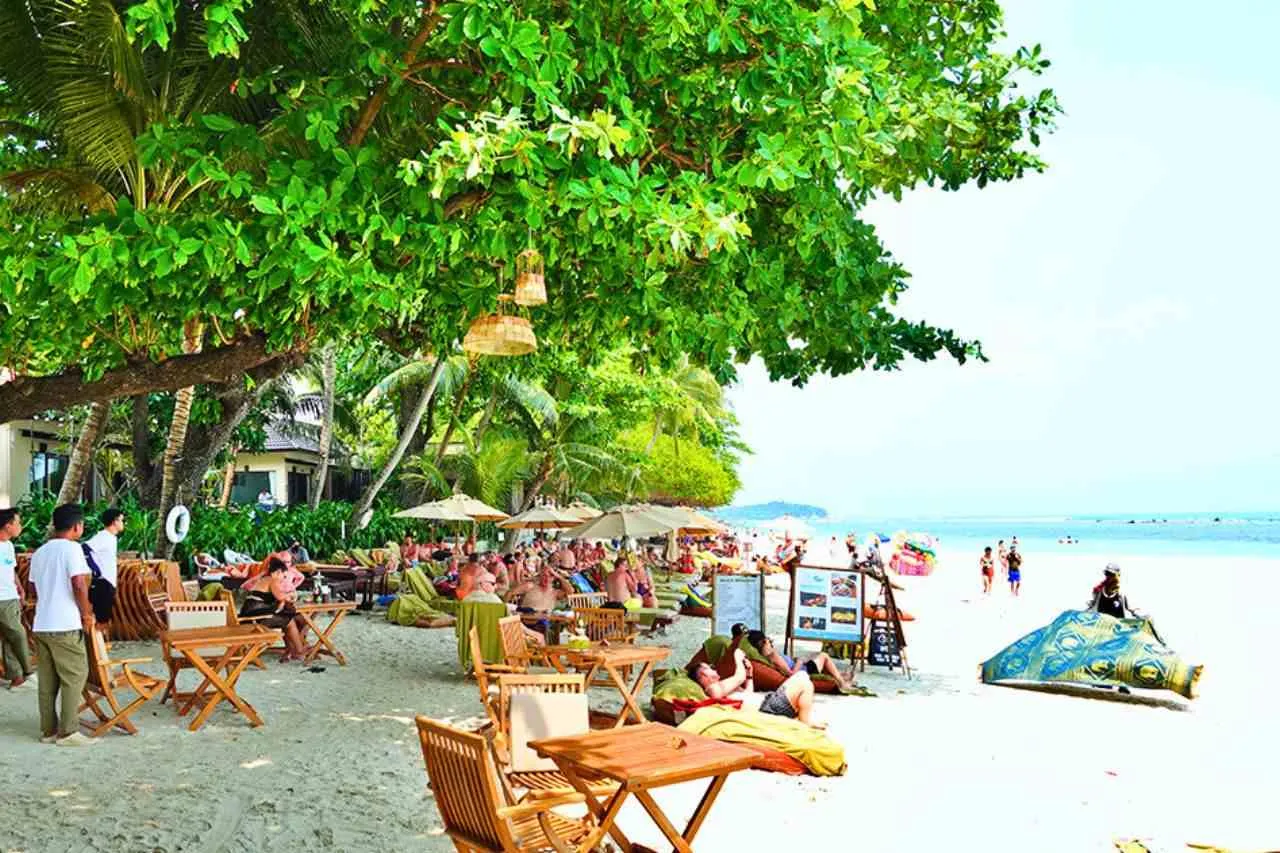
Tourists on a beach in Koh Samui. Photo: Khaosod
Thai tourist centers are operating normally.
Bangkok, Chiang Mai, Phuket, Pattaya, and Koh Samui remain peaceful; no border-related incidents have occurred outside the exclusion zone.
Airports, trains (except for lines to closed borders), and attractions are operating as usual.
Domestic flights continue normally, although Ubon Ratchathani and Buriram airports may experience minor delays due to military traffic.
The train on the eastern line bound for Aranyaprathet now stops at Sa Kaeo or Kabin Buri to prevent travelers from entering the conflict zone.
Quick tips for travelers

Tourist with a backpack in front of Wat Arun in Bangkok. Photo: The Nation Thailand
To do
Stay on tourist routes in central, northern, and southern Thailand, hundreds of kilometers from the border and completely safe.
Don'ts
Visit border markets, temples, or parks in the provinces within the exclusion zone.
Military checkpoints are turning back civilians and the risk of artillery or rocket fire is real.
Insurance
Read the general terms and conditions carefully.
If you visit the islands of Trat, check that your coverage does not exclude areas not recommended by the government.
Stay informed
Follow official embassy alerts, not social media rumors.
Crossing borders
Fly between Thailand and Cambodia.
All land border checkpoints remain closed.
Bangkok-Phnom Penh and Bangkok-Siem Reap flights are operating normally.
The conflict with Cambodia does not affect your trip to Thailand
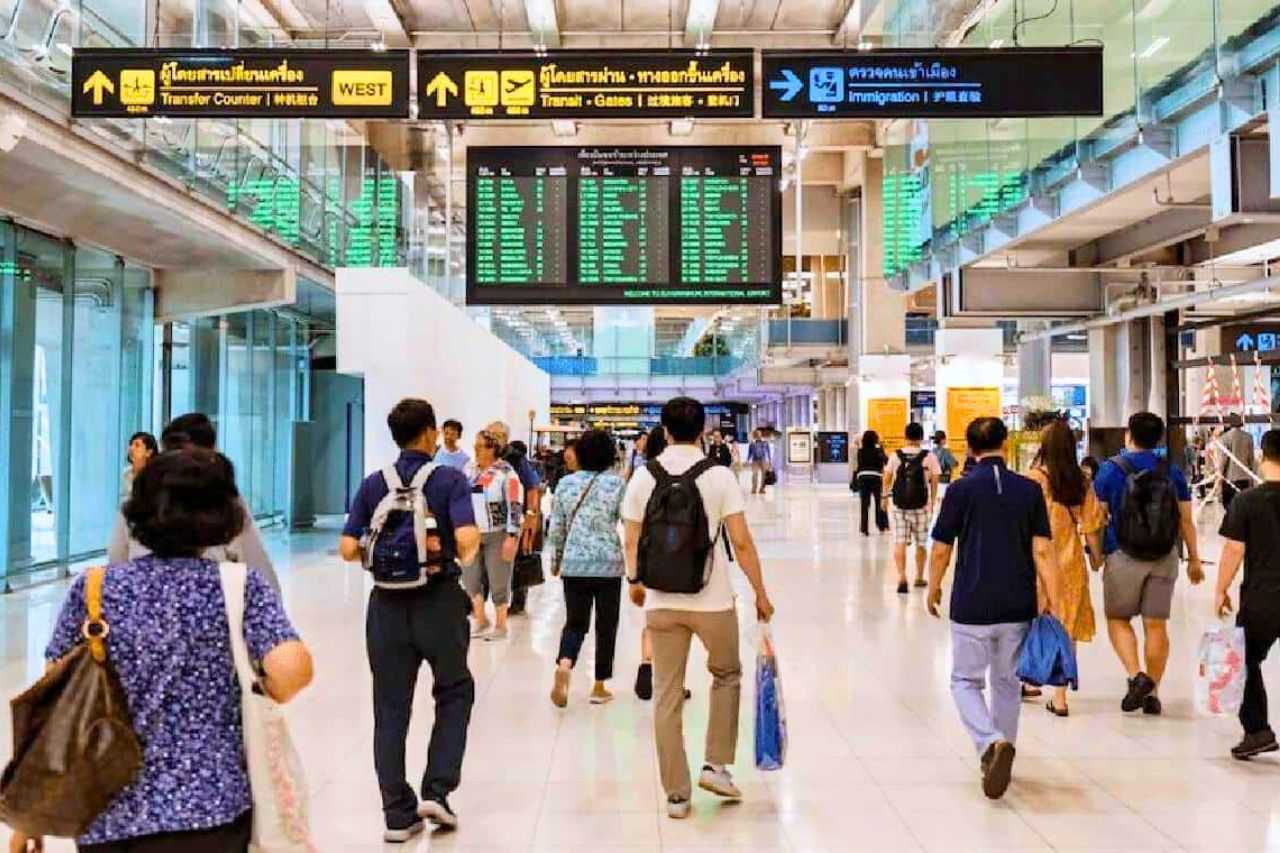
Travelers at Suvarnabhumi International Airport in Bangkok.
Thailand remains a safe country for tourists who wish to travel there, and the border conflict with Cambodia occupies less than 5% of Thai territory, in remote rural areas.
Unless your itinerary includes the Cambodian border provinces, the conflict will have no impact on your trip.
By respecting the exclusion zones and checking their insurance for the islands of Trat, travelers can confidently enjoy Thailand throughout 2026.
More than 95% of Thai territory remains completely outside the conflict zone.
See also:
Thailand accuses Cambodia of war crimes
Cybercrime in Cambodia: Trip.com ends partnership
Thailand-Cambodia conflict: the army says it is targeting cybercriminals and casinos
Source: The Thaiger
Prepare your trip to Thailand
Book bus, train, or boat in Thailand
Manage your money while traveling with Wise
If our news, tourist information, or cultural content has been useful to you and you'd like to thank us:
You can follow us on:
Twitter, LinkedIn, Facebook, Google News
Or install our app:
Install the Toute la Thaïlande app on your smartphone
