
To know everything about Muay Thai, Thai Boxing, a national martial art in Thailand, renowned as one of the most effective combat sports.
Menu
Presentation of Muay Thai
Thai boxing, or Muay Thai, is a combat sport originally created for Thai military personnel in the 16th century.
Muay Thai is also known as "the Art of Eight Limbs" or "the Science of eight limbs", because it uses punches, kicks, elbows, and knee strikes, thus utilizing eight "points of contact".
See: Muay Thai techniques with illustrations
A Muay Thai practitioner is known as a nak muay.
Western practitioners are sometimes referred to as Nak Muay Farang, meaning "foreign boxer" (see the meaning of farang in Thai language, the minimum vocabulary to know on the first trip).

This martial art is classified in the West among kickboxing (BPP).
Fights take place over five three-minute rounds.
See: The rules of Thai boxing (Muay Thai)
They are preceded by the Wai Kru, a greeting to the trainer, and the Ram Muay, a ritual dance.
See: The Ram Muay, a ritual dance before Muay Thai fights
And: Thai boxing music
Muay Thai has its origins in ancient martial practices, such as Muay Boran (traditional boxing) and Krabi Krabong (practice with weapons).
High-level Muay Thai requires:
- Good brain capabilities
- Mental abilities essential, such as determination, will and courage.
- Strong technical skills with physical skills such as muscular flexibility, speed and reaction capacity to a signal (reflexes); and moreover, for the K.O-system fight,
- Muscle power.
Muay Thai is a very popular sport due to its effectiveness, it surpasses a large number of other combat sports when competitions are organized (such as with fighters practicing Karate, Kung Fu, English Boxing…).
Among other Southeast Asian boxing styles (Burmese boxing, Khmer boxing, Laotian boxing, Vietnamese boxing), it is the most popular of the five disciplines.
Like its cousins, it has a reputation for being a violent practice, but on the contrary, practitioners believe that any technique can be controlled.
Roger Paschy, one of the pioneers of this sport in France, speaks about it as follows:
“Thai boxing cannot be a sport that people wrongly call a thug sport.
It requires a lot of willpower and dedication.”
But, as in any sporting activity, the teacher has a fundamental role in the training of the student.”
The teacher's mindset will have a considerable influence on the student.”
History of Muay Thai
The origins, ancient history and image of Muay Thai are presented in a standardized way in an abundant literature in Thailand.
The oldest historical data, which would attest to boxing practices before the 19th century, are mainly inspired by the royal chronicles, rewritten several times (notably under Rama I), after the destructions of the 18th century (fall of Ayutthaya in 1767).
It is therefore difficult to confirm the historicity of the legends and the origins of Muay Thai.
Similarly, it is necessary not to ignore the strong ideological, particularly nationalist, tenor that presides in Thailand over the presentation of the origins of Thai boxing (and Muay Boran), its ancient history, and its contemporary image.
See: Who invented Muay Thai, Thailand, Myanmar, Cambodia?
The fight of the sons of King Sen Muang Ma
According to tradition, in 1411, upon the death of King Sen Muang Ma, his two sons, Ki and Fang, wanted to seize power.
As their respective armies failed to distinguish themselves on the battlefield, they decided to settle their conflict with a duel.
Each side chose its best boxer. Fang's man was defeated and Ki ascended to the throne.
The combat technique of his warrior (boxer) became a school.
The popularity of Muay Thai
In the 16th century, Thai boxing was part of military training. King Naresuan the Great (r. 1590-1605) is said to have encouraged its practice as such.
It reached its greatest popularity at the beginning of the 18th century, under the reign of Pra Chao Sua, 'the Tiger King'.
It was the favorite pastime of the population; each village organized fights regularly.
The king, who was a top-notch boxer, enjoyed challenging local champions!
The first equipment of boxers
At the time, fighters protected their fists by wrapping their hands with horsehair.
Later, the horsehair was replaced by cotton strips held together with glue.
They used shells or tree bark as a shell!
Sometimes, with the agreement of the two boxers, pieces of glass could be mixed into the glue of the bandages.
At that time, the fights took place without weight categories or time limits (a fight known as 'to the finish').
The legend of Nai Khanom Tom
According to legend, Naï Khanom Tom, a soldier and boxer captured by the Burmese in 1767, was pitted against ten Burmese champions whom he knocked out.
He became a national hero, to whom the Thais pay homage every year on the occasion of the "Night of the Boxers".
New rules to make Muay Thai less dangerous
Considered dangerous, even deadly, Thai boxing was banned in 1921.
Then, around 1930, it reappeared by adopting the competition rules and fist techniques of English boxing (boxing gloves, ring, rounds, ban on headbutts, etc.).
The different styles of Muay Thai

Ram-muay, traditional dance before a Muay Thai fight
Muay Thai is a descendant of Muay Boran, a martial practice with several regional styles, and certain traditional martial practices (some of which are inspired by animal behavior).
Among the most well-known styles, we find:
Muay Chaiya or "Muay Giow" (style of the South), this 19th-century style emphasizes mental agility to find effective strategies.
The posture is angular, defense is privileged, and elbow and knee techniques are particularly pronounced.
Techniques derived from animals (notably the tiger) are used.
"Muay Korat" (East and Northeast), emphasizes a strong work, such as buffalo techniques.
the "muay-lopburi" (central region), the emphasis is on intelligent gestures (work on trajectory variations and weapon feints).
the "muay-thasao" (North), the techniques consist of taking speed against the opponent
And thematic styles such as the techniques of the white monkey (said to be Hanuman).
A formula summarizes the main styles of muay-boran :
"The powerful fist of Korat, the spirit of Lopburi, the posture of Chaiya and the speed of Thasao."
These non-competitive practices of Thai martial art are grouped together (in Thailand) under the term "mae-mai muay-thai".
The Mongkhon and Pra Jiad

The Mongkhon (headband) and the Pra Jiad (armbands) are often worn on the ring before the start of the match.
They date back to the time when Thailand was in a state of constant war, where young men would tear off clothing from a loved one (often their mother's sarong) and wear it to fight for good luck and to ward off evil spirits.
In modern times, the Mongkol (literally meaning healthy spirit, luck, and protection) is worn as a tribute to the fighter's gym.
The Mongkol is traditionally presented by a trainer to the fighter once he feels that the fighter is ready to represent the gym's name on a ring.
When the fighter has finished the Wai Kru (salute to the teacher), the coach removes the Mongkol from his head and places it on their corner of the ring for good luck.
Whether the fighter is Buddhist or not, it is common for them to bring the Mongkol to a Buddhist monk who blesses it before stepping into the ring.
Muay Thai in Thailand
National sport and real industry, Muay Thai supports around 200,000 people, fighters, trainers, merchants, etc.
This huge commercial business is managed by two organizations made up of promoters, who organize fights every day.
The number of practitioners is estimated at 100,000 and every week hundreds of fights take place across the country.
Many small training clubs (called 'camps') are scattered throughout the country and welcome young people from the age of seven.
Major fights are regularly broadcast on Saturdays and Sundays by regional and national television channels.
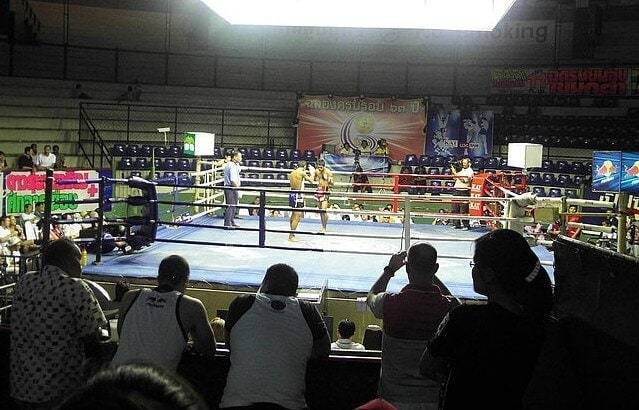
The two most well-known Thai boxing stadiums are located in Bangkok: they are the Lumpinee Boxing Stadium and the Rajadamnoen Stadium.
Known worldwide, they are considered the reference stadiums for Muay Thai.
The Lumpinee Stadium was relocated in 2014 to the north of Bangkok, in Lat Phrao.
The Rajadamnoen Stadium, the most prestigious and oldest, is located on Rajadamnoen Nok Road, opposite the headquarters of the Royal Thai Army, which manages it.
Take Muay Thai classes in Thailand
The Thai government has set up a website to allow foreigners interested in this sport to find courses throughout Thailand.
The site: Now Muay Thai
See also: Take a Muay Thai course in Thailand: The Beginner's Guide
Internationalization of Thai boxing
The development of tourism in Thailand has introduced Muay Thai to other nations.
It first spread to the Netherlands and then quickly competed in France with full-contact (American boxing) and American kick-boxing (low-kick), both in its 'genuine' version and in its Japanese version, Japanese kick-boxing (or K-1).
In 1966, Kenji Kurosaki, a kyokushinkai karate practitioner, challenged a Thai boxer and was knocked out in the first round.
After this fight, he stayed in Thailand for several months to study Muay Thai, which he later introduced to Japan under the name kick-boxing.
Video of a Muay Thai fight
A video of a fight between two Muay Thai legends, Nokweed Davy and Jerome Le Banner.
Documentary on the secrets of Thai boxing
French journalists immersed themselves in an authentic Muay Thai school!
A surprising report that also presents all the combat techniques as well as a complete history of this nearly thousand-year-old martial art.
If you want to go further, I recommend one of the best books on Muay Thai:
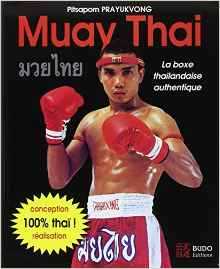
Abundantly illustrated, this book will satisfy the expectations of both beginners and experienced practitioners.
This guide is the result of consultation between several experts in Thai boxing.
It presents all facets of this art, which is well-established in France and Europe:
– History, myths and traditions of Muay Thai,
– Equipment and ceremonials,
– Warm-up and combat preparation,
– Fighter's footwork,
– Descriptions of strikes (fist, elbow, knee, foot…),
– Dodges and blocks…
You will find accessories (gloves, shorts, oils) on:
Muay Thai store on Amazon
Photos: Muay Thai fight: C_Scott ; Muay Thai fight: tacofleur ; Fighters performing Wai Kru: WMF Japan ; Rajadamnern Stadium: kwankwan ; Source: Wikipedia
Do you like Toutelathailande.fr?
👉 Leave us a review on Trustpilot.
Your review strengthens the credibility of our work and the trust of our readers.
Useful links to prepare your trip to Thailand
Book bus, train and boat in Thailand
Manage your money while traveling with Wise
If our news, tourist information, or cultural content has been useful to you and you'd like to thank us:
You can follow us on:
Twitter, LinkedIn, Facebook,Google News
Or install our application: Install the application of All Thailand on your smartphone
