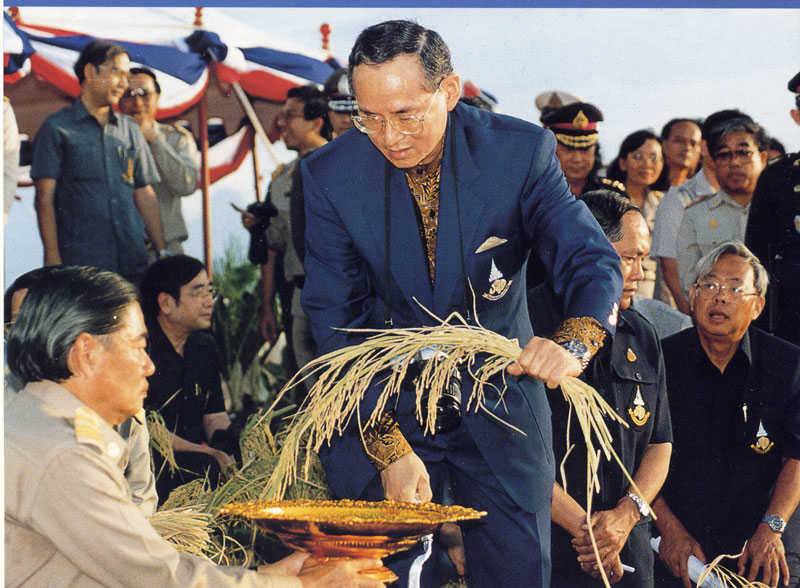
His Majesty King Bhumibol Adulyadej was a visionary who did everything to make Thailand strong, independent, and able to resist global crises and famines with a self-sufficient economy.
Today, more and more serious economists fear a terrible global economic crisis:
See: risk of global economic crisis
If unfortunately, it happened, it could create civil wars and terrible famines in countries that have let multinationals manage their food supplies.
One of the solutions to avoid this is self-sufficiency economy as it has been advocated since 1974, by King Rama IX.
At a time when large agri-food companies, such as the multinational Monsanto, are attempting to take global food control, the king's work on self-sufficiency economy (si sa kiet po piang in Thai) is of crucial importance to enable countries to maintain their food independence.
Menu
The self-sufficiency economy, anti-Monsanto
Here is an article by Tristan Lecomte / Alter Eco, published on 08/16/2010
“The king of sustainable development is Thai”
Since 1974, His Majesty King Bhumibol Adulyadej, Rama IX, the sovereign of Thailand, has been advocating for a self-sufficiency economy. Hopefully, his example will mark history…
Thailand is known for its dream landscapes, mass tourism, and refined cuisine, but beyond these clichés, its king, Bhumibol Adulyadej (Rama IX), and his development theses, implemented in different parts of the country by millions of small farmers, are little known.
King since 1946, he is the sovereign who has had the longest reign in history.
Still in power, he has been promoting since 1974 the model of self-sufficiency economy ("self-sufficiency economy").
He encourages small farmers to primarily seek food self-sufficiency, diversification of their production, and less dependence on the purchase of manufactured goods.
More broadly, it proposes an attitude of moderation, integration into the ecosystem and cooperative and solidarity-based organization within village communities.
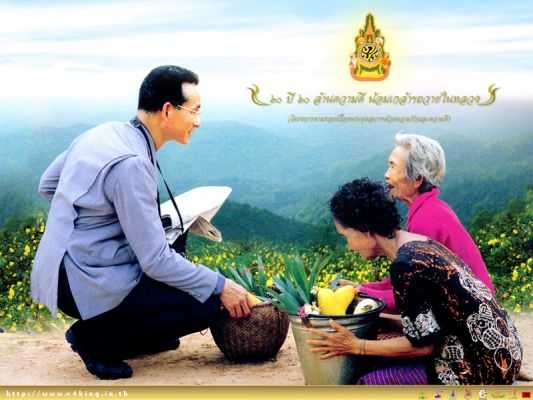
The King of Thailand's development projects
Highly inspired by Buddhism, and close to the localist theses of thinkers such as Ernst "Fritz" Schumacher, author of Small is beautiful, the king's ideas have long amused the "businessmen" of the Thai establishment, particularly during the 80s and 90s economic boom.
The 1997 crisis that strongly hit Thailand, and more globally the current global crisis of capitalism and its ravages on the environment, now give his theses an unparalleled impression of modernity.
One of the underlying concepts of self-sufficiency economy is that of 'social immunity' that producers and their communities must seek through diversification of their resources and research, above all, into food self-sufficiency, before engaging wholeheartedly in the development of intensive cash crops and consumerism.
Thus, in the face of a globalized economy and the unbridled development of mechanized intensive agriculture and monoculture throughout the world, which has never really enriched farmers, the King has continually advocated a moderate development model, step by step, and above all, very diversified.
For example, it very concretely recommends that each producer divide their farm into four, with 30% dedicated to rice cultivation, primarily intended for family consumption, with the surplus being marketable, 30% dedicated to building a water reserve to meet agricultural needs even in times of drought, 30% dedicated to food crops, vegetable gardens, fruit trees, as well as raising chickens, ducks, cows, and buffalo, both for family food and the production of natural fertilizers for crops, and finally 10% for housing and access to the farm.
Thus, it provides a very practical and accessible illustration to everyone of its theory.
He developed model farms and training centers throughout the country following this scheme, starting with the model organic farm he installed at the heart of his Royal Palace in Bangkok…
He is a grassroots king, too old to travel now, but who traveled the country for decades, tirelessly, to meet small producers and offer them something other than the intensive model and the single thinking.
A visionary king who dared to go against the current of this single thinking, by promoting organic farming, agro-ecological techniques and principles of morality inspired by Buddhist spirituality: moderation, cooperation, respect for life in all its forms.
The king of sustainable development, organic farming and fair trade in a way.
Let us hope that his example will mark history and inspire our political leaders to further promote these sustainable orientations and practices and to defend a true vision of development. »
To complete, here is an excerpt from an article by Tony Cartalucci :
Thailand's response to globalization
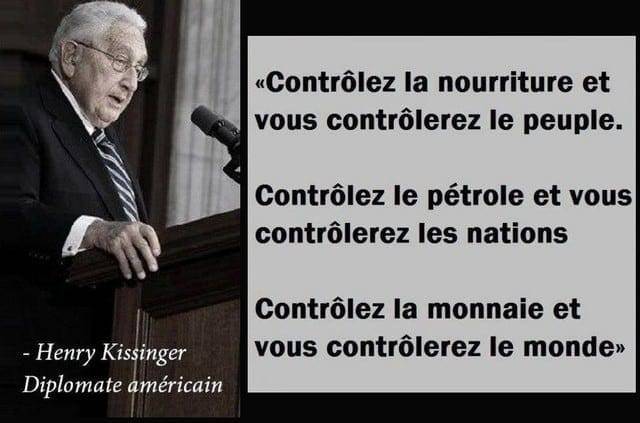
And they also control the media…
Thailand's response to the IMF and globalization in general has been profound both in its implications and in its understanding of the final game of globalization.
Fiercely independent and nationalistic, and being the only nation in Southeast Asia to avoid colonization, Thailand's sovereignty has been protected for over 800 years by its revered monarchy.
The current dynasty, the House of Chakri, has reigned almost as long as America has existed as a nation.
And just as it has done for 800 years, the Thai monarchy today provides the most provocative and significant response to the threats facing the Kingdom.
The answer is, of course, the economy of self-sufficiency.
Self-sufficiency as a nation, province, community, and household.
This concept is embedded in the "New Theory" or "self-sufficiency economy" of the Thai King and reflects similar efforts around the world to break the back of oppression and exploitation resulting from dependence on an interdependent globalized system.
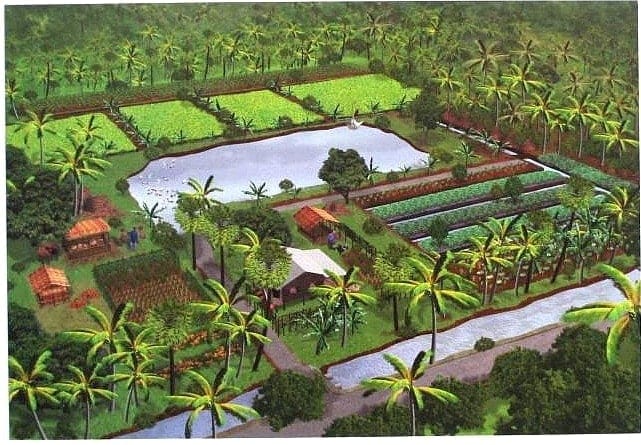
Image: A vision of self-sufficiency in Thailand. Agrarian values and the self-sufficiency they generate are the hallmarks of true freedom.
The foundation of the self-sufficiency economy is simply to cultivate your own garden and provide your own food.
This is represented on the back right side of every 1,000 baht Thai banknote as an image of a woman tending to her garden.
The next step is to produce a surplus that can be exchanged for income, which can then be used to buy technology to improve your ability to provide for your needs and improve your lifestyle.
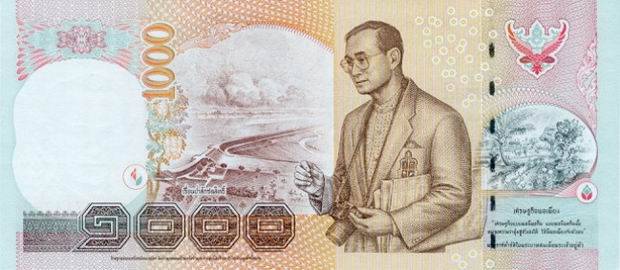
Image: The Thai banknote 1000 baht. On the left one of the many dams controlling floods and producing electricity throughout the Kingdom. In the center is King Rama IX. On the right: a representation of a local garden providing food in a self-sufficient manner.
Self-sufficiency economy: the new theory
The New Theory aims to preserve traditional agrarian values in the hands of the people.
It also aims to prevent migration from the countryside to the cities.
The prevention of such migrations would prevent large agricultural cartels from entering, swallowing up agricultural land, corrupting and even jeopardizing the entire national food supply (see Monsanto).
Those who are familiar with the UN's Agenda 21 and the more recent "Climate Change Programme" of the United Nations can understand the deeper implications and dangers of such migration and why it must be stopped.
By moving to the city, people abandon private property, stop engaging in productive activities and end up being folded into a consumerist paradigm.
In such a paradigm, problems like overpopulation, pollution, crime and economic crises can only be addressed by a centralized government and generally provide political solutions such as quotas, taxes, micro-management and regulations rather than meaningful technical solutions.
Moreover, such problems inevitably lead to a centralized government that increases its own power, always at the expense of the people and their freedom.
The effects of the economic catastrophe are also greater in a centralized and interdependent society, where everyone is subject to the overall health of the economy even for simple necessities like food, water and electricity.
Under the "New Theory", demonstration stations have been set up throughout Thailand to promote education in agriculture and self-sufficiency.
The program is in competition with the contemporary globalization system, which from now on, is mired in many regions of the world with the economic crisis.
The relatively self-sufficient nature of Thais in general has fairly well resisted this economic chaos.
In 10 years, a plate of food still costs the same amount of money, as do many everyday consumer products.
This only reinforces the value of the self-sufficiency economy and, more than ever, in Thailand and abroad, it's a good time to get involved and become self-sufficient. »
Tony Cartalucci's article then continues on the criticism of this self-sufficiency economy by US media, economists, and politicians, and their support for the ultra-liberal policies of Thaksin Shinawatra and his sister Yingluck,
You can read the full article in English here:
Self-Sufficiency: A Local Solution to a Global Problem
Years ago, I had discussed this self-sufficiency economy taught throughout the country with a Thai friend. At that time, he loved his king and was proud that a foreigner was interested in this policy.
But then, he had gone to follow a leadership training for the red shirts or UDD (pro-Thaksin movement, an ultra-liberal politician supported by the United States) and one of the first things he told me upon his return was that this self-sufficiency economy was stupid and he had also become anti-royalist.
The Shinawatra family is linked to the Carlyle group which includes Monsanto, and if you don't know what Monsanto is, then you should watch this documentary:
I don't know if this documentary has been translated into Thai, but if not, and if you know someone who can do it, it would be really useful, because I had met a Thai farmer who was very proud to tell me that he used Monsanto seeds, a company that has destroyed the lives of many farmers around the world, poisons the world and threatens our future:
Monsanto is already well established in the country, but is not allowed to use its GMOs.
Prepare your trip to Thailand
Book bus, train, or boat in Thailand
Manage your money while traveling with Wise
If our news, tourist information, or cultural content has been useful to you and you'd like to thank us:
You can follow us on:
Twitter, LinkedIn, Facebook, Google News
Or install our app:
Install the Toute la Thaïlande app on your smartphone

2 comments
A great video on an easy method to have a very productive garden without too much maintenance, if you know nothing about gardening and even if you know, you will be amazed by the simplicity of this method:
https://www.youtube.com/watch?time_continue=1144&v=Eh2Woo9A1HY
Excellent article, unfortunately rarely discussed topic. King Rama IX was indeed a great visionary, a sincere humanist who did more than anyone for his People. I shared this article on my two Facebook groups dedicated to Issan and retirement and expatriation in Thailand.