
All stages of Buddha's life, his birth, enlightenment, death, and how his teachings subsequently spread throughout the world.
Summary
Presentation
The birth of Buddha
Life in the palace and marriage
Discovery of suffering
Renunciation and asceticism
Awakening of the Buddha
Teaching of Buddha
Personality and character of the Buddha
Physical characteristics of Gautama Buddha
Gautama Buddha in Hinduism, Islam and Christianity
Buddha, Christian saint!
Documentary on the life of Buddha
Some teachings of the Dharma
Presentation
The Buddha, whose personal name was Siddhartha and family name Gotama, lived in northern India in the 6th century BC.
His father, Suddhodana, ruled the kingdom of the Sakya (in modern Nepal).
His mother was Queen Maya (Māyādevī).
The Buddha "the Awakened", Siddhartha Gautama is also called Shakyamuni "sage of the Śākyas".
It is sometimes referred to as the Buddha Shakyamuni to distinguish it from other Buddhas.
The Birth of Buddha
He was born in Lumbini, on the road to Kapilavastu, the capital of the family clan, in the current Nepalese Terai.
The accounts of Siddhartha's birth are filled with mythical details: his mother Maya (whose name means "illusion") is said to have conceived him in a dream, penetrated in the womb by a white elephant with six tusks.
She is said to have given birth standing up, clinging to a tree branch, while the Brahmanic deities rained flower petals on her.
As soon as he emerged from his mother's side, the child is said to have stood up and "taken possession" of the Universe by turning towards the four cardinal points, then took seven steps towards the north.

The birth of Buddha
Māyādevī is said to have died a week later, entrusting her son to her sister and co-wife Mahāprajāpatī Gautamī.
The sage Ashita, former guru of Suddhodana (Buddha's father) and then a hermit in the Himalayas.
He is said to have seen, thanks to his powers, the birth of Siddhartha and came himself to examine the child, on whose body he recognized the marks of a Buddha.
When choosing a name on the fifth day, eight eminent brahmins were present; seven predicted that the child would be either a great king or an ascetic, but the youngest, Kondañña, also clearly saw that he was the next Buddha.
The name given to him is not specified in the accounts of the ceremony.
Life in the palace and marriage of Prince Siddhartha
Some texts in the Pali Canon claim that he had his first meditation experience and attained the first degree of jhana (states of concentration, meditation) while still a young child, sitting under a jambu tree during a plowing ceremony performed by his father.
Other texts place the event later in his life.
According to the Jatakas, it was at the age of sixteen that he married the young princess Yaśodharā who gave him a son, Rāhula.
According to André Bareau, Rahula's mother was ignored by the first four Nikayas and Agamas, but her legend developed with many details from the 1st century BC.
The Buddha is said to have spent his first twenty-nine years in the observance of Hinduism and trained in the handling of the bow like a true kṣatriya (warrior caste), but was kept sheltered from the sight of suffering and death, and even kept within the confines of the family palace according to some versions.
The Brahmins having predicted for him a future as a king or an ascetic had, in fact, recommended that his father take this precaution if he wanted to avoid the second option coming true.
Śuddhodana certainly hoped that his son would become a king and thought that a life of ease would prevent him from thinking about the difficulties and suffering.
Prince Siddhartha discovers suffering
The young Prince Siddhartha lived in his palace endowed with all the luxury at his disposal.
But he finds himself confronted with the reality of life and the suffering of humanity and then decides to find a solution.
The Four Encounters that Changed the Life of the Future Buddha
The encounter with an old man makes him aware of the suffering of the passing of time and the decay of the aging body.
The encounter with a sick man teaches him that the body also suffers independently of time.
The encounter with a corpse being taken to the pyre reveals to him death in all its sordid character.
Finally, the encounter with a hermit shows him what wisdom might be.
According to various sources in the canon, after the first encounter, he shares his astonishment with his charioteer, Channa, who takes him outside the palace where he discovers the other signs and becomes fully aware of the multiple facets of suffering.
He then decides to find a solution to put an end to it.
Renunciation and asceticism of Prince Siddhartha
At the age of twenty-nine, shortly after the birth of his only son, Rahula, he abandoned his kingdom and became an ascetic in search of a solution.
According to the Pali tradition, it was on a full moon night in the month of āsālha (July) that he left the kingdom of Kapilavastu on his horse Kanthaka accompanied by his charioteer Channa, the four celestial guardians muffling the gallop and neighing of the horse so that no one would notice anything.

Siddhartha Gautama with his charioteer Channa and Kanthaka
For six years, the ascetic Gotama wandered in the Ganges valley, meeting famous religious teachers, studying and following their systems and methods, and submitting to rigorous ascetic practices.
He had the Brahmin Arada Kalama as his teacher, but what he learned – mastering the seventh dhyana, the sphere of nothingness – did not seem sufficient to him.
He went to Rajagriha and took Udraka Ramaputra as his second teacher, who taught him the eighth dhyana, the sphere of neither perception nor non-perception.
Again, the Buddha felt that he had not found the path to Nirvana.
For six years, he practiced austerities with five other meditating ascetics, including Kondañña, who had identified him as a future Buddha at his birth.
Weakened by his abstinence, he nearly drowned one day while bathing.
Realizing that these practices had not led him to a greater understanding of the world, he decided to find another path.
He then recalled the past episode where he had attained the first jhāna (illumination) under a jambu tree.
He decided to abandon extreme austerities and focus on meditation, tracing the middle path that denies excesses, refusing both laxity and excessive austerity.
His companions thought he was abandoning his practice and left him.
The Enlightenment of the Buddha
On the same day, meditating under a banyan tree at Uruvelā near Bodh-Gaya, he ends his mortifications by accepting a bowl of milk rice from the hands of the village girl Sujāta.
Then, after a ritual bath and an afternoon of meditation in a grove of sal trees, he goes to sit under a pipal tree and makes a vow not to move from this spot until he has attained the ultimate truth.
Several legendary versions tell how Mara, the demon of death and passions, frightened by the power that the Buddha was about to gain against him, tries to distract him from his meditation by launching hordes of frightening demons against him.
In fact, the battle with Mara can also be likened to the mental struggle of Buddha, against evil thoughts, desires, and lack of concentration.
But Mara's attacks are in vain: it is with the gesture often represented in iconography of "taking the earth to witness" his past merits (bhûmisparshamudra) that Siddhārtha repels them, simply denying the demonic presences without fighting them, in all serenity.
He can thus continue his night of meditation and attain enlightenment at dawn.
The following four to seven weeks, depending on the version, see the sporadic return of Māra and his seductive daughters, still without effect.
The Buddha meditates in different places, including a shelter formed by the body of the naga king Muchalinda.
Indeed, a terrible downpour took place, causing the neighboring lake to overflow.
Completely absorbed in his meditation under a tree, the Buddha didn't notice it and continued to meditate despite the danger.
Muchalinda, the naga king living in the tree or the lake, lifted him up or surrounded him with seven coils and sheltered him from the rain with his seven hoods.
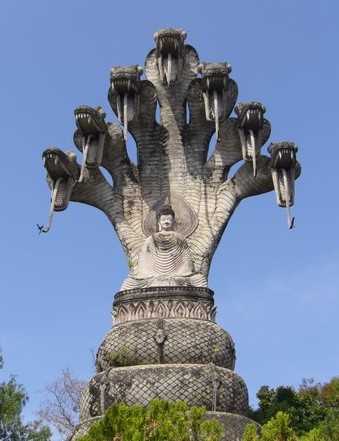
Representation of Muchalinda protecting Buddha
It was thus that one evening, seated under a tree (known since as the Bodhi tree or Bo, "the tree of wisdom") on the banks of the Neranjara river, at Bouddha-Gaya (near Gaya, in modern Bihar), at the age of thirty-five, Gotama attained Enlightenment, after which he was known as the Buddha, "the Awakened".
Having become Gautama Buddha, he hesitates to teach, wondering if such a word will be heard.
Tradition brings in a Nâga who convinces him to share his knowledge with humanity.
In another Buddhist legend, a Nâga who has taken on the appearance of a man tries to follow the teaching and Buddha discovers him and explains to him that this teaching is only for men.
The Nāga then asks him a favor: that all those who want to follow his teaching be called Nāga before becoming a monk, and the Buddha is said to have accepted.
That is why, in Thailand, candidates for ordination are first called "nak » Nāga.
Buddha preached his first sermon to a group of five ascetics, his former companions, in the Deer Park at Isipatana (modern Sarnath) near Benares.
In the first sermon of Gautama, the setting in motion of the wheel of the law, he enunciates the four noble truths.
He affirms that he has realized the awakening or the total understanding of the nature and causes of human suffering and the necessary steps for its elimination.
This enlightenment, possible for all beings, is called bodhi and gives its new name to Siddhartha: one who has attained bodhi is a Buddha.
Gautama Buddha strongly emphasized that he was neither a god nor the messenger of a god and that enlightenment was not the result of a supernatural process or agent, but rather the result of a particular attention to the nature of the human mind, and that it could be rediscovered by anyone for their own benefit.
Two different interpretations of this statement divide the ancient Buddhism and the Mahayana Buddhism.
The first is that it is possible for each person, as a listener to Gautama's teaching, to attain enlightenment and escape from Samsara.
The second is that every sentient being possesses the Buddha nature (tathāgatagarbha) within, the true nature of the mind, sometimes referred to as the "seed of enlightenment".
This interpretation, which postulates the existence of a universal ontological or transcendent nature, is rejected by orthodox Theravada.
The teachings of Buddha
From that day on, for forty-five years, Buddha taught all classes of men and women - kings and peasants, brahmins and outcastes, bankers and beggars, religious and bandits - without making the slightest distinction between them.

And in the Buddhist religion, one is not asked to blindly believe; Buddha Sakyamuni said to his disciples:
Do not accept my teachings without truly studying them.
If someone gives you a gold nugget, you will naturally verify it in every possible way to check if it is really gold.
In the same way, act with my teachings to recognize their validity and accept them.
The "Benares Discourse", the Buddha's first public teaching
The Doctrine (Dharma) was expounded by the Buddha in a teaching known as the "Four Noble Truths".
This is the main teaching of his first public discourse, in Benares, shortly after his Awakening.
It is presented as a medical exposition:
1st Truth: the symptom - dissatisfaction is inherent in human existence;
2nd Truth: the diagnosis – this dissatisfaction finds its origin in ignorance and the desire for appropriation, characteristic of the ego;
3rd Truth: the therapeutic – there exists a state of health where, ignorance being abolished, desire is not expressed and does not give birth to dissatisfaction;
4th Truth: the remedy – to regain this state of health, it is advisable to follow a Path (a discipline of life divided into eight "branches": "the Noble Eightfold Path") which puts an end to ignorance and desire.
If the observation made by the Buddha seems pessimistic (all existence is subject to dissatisfaction), his teaching, on the other hand, is optimistic since it affirms that everyone can regain health, where all dissatisfaction is abolished.
To achieve good health (one's own 'Buddha nature'), one must devote oneself to study and training.
The first three 'Truths' invite study, which allows us to understand the origin of dissatisfaction (the nature of the mind and phenomena), explains why our usual experience is 'erroneous', and proclaims the possibility of putting an end to Ignorance.
These first three 'Truths', developed, explained and commented on, constitute the doctrine.
The fourth 'Truth' advocates training through the concrete application of methods capable of transforming the usual experience into an experience of awakening, free from all distortion and confusion.
This fourth 'Truth' sets out the principles that will give rise to the different forms of practice.
The doctrine taught by Buddha
The Buddha begins by explaining 'our' view of reality, then proposes a new analysis, and finally teaches how to see things as he sees them, that is to say 'as they are'…
The 'Self' and the ego
In our usual experience, we consider the world and its phenomena, our body and our mind, or our feelings and our ideas… as if they were related to each other, but fundamentally independent of each other and shaped on models – what is called an 'essence', a 'Self'.
To explain the variety of the world, we imagine that each individual, each phenomenon is in fact just a kind of 'variation' on the theme of this 'Self': horse, tree, rain, mountain, star, anger, freedom, love…
As far as our mind is concerned, we firmly believe in the existence of an 'ego' (âtman), insubstantial and permanent, which, through the body, apprehends the world, experiences feelings, reasons, and conceives ideas.
The ego, even more than the body, is what seems to constitute our personality, our individuality, what belongs to us.
Impermanence and suffering
At every moment of our lives, we can see that everything in nature is subject to death.
Everything that appears will disappear one day or another.
It's also the case for our own body, as for all living beings and all material things.
It's also the case for our feelings and our ideas: like the stars or the mountains, our love appears one day and will disappear one day, and we change our ideas and opinions.
It's this impermanence that makes us suffer.
Because we see that everything dies - everything that has a 'Self' for us - we fear that our own ego is also mortal!
But it is with things as with the ego: nothing exists 'in itself', independently.
Everything – including our ego – is born and dies. It is because we refuse this reality of things, “as they are,” because we maintain the illusion of the existence of a “Self,” that we suffer.
Karma and rebirth
In our daily lives, all our actions (karma) are closely dependent on this view of things: our actions, reactions, desires and fears are determined by this belief in the ego.
It is to maintain, protect and develop it that we act or react, depending on our ideas and feelings or external events.
Whenever someone or something seems to be putting us in question, we act as if to prove to ourselves that we exist, that this ego exists.
Each of our actions, thus, is born from this intention to prove its existence and, once the act is done, we rejoice in having proven it.
Whenever our ego is in danger of death, we do everything to make it reborn, to keep it alive…
It is the belief in the ego that nourishes the intention of each of our actions and it is the attachment to the result of these actions that maintains our belief in the ego.
Each act thus leads to a « new birth » – a rebirth – of the ego.
Interdependence
But, in fact, all phenomena exist only in interdependence.
Physical objects are compounds.
Just as a mountain is an aggregate of stone, earth, and vegetable or animal residue, our body is composed of cells that come to us from our parents, the food we eat, and the air we breathe.
Our perceptions, too, are "compounded".
They are the combined result of the existence of external objects, their contact with our body, the impression they leave on our senses, and the interpretation made by our brain.
Our ideas, too, are compounded.
They depend on the education we have received, our perception of the outside world, the events we have experienced, and the ideas expressed by other people.
And our ego - the idea we have of ourselves - is an idea like any other…
Emptiness and the mind
Reality appears to us as a dual relationship: there would be a subject (the ego) that would experience objects (external phenomena).
According to the Buddha, this 'objective' reality does not exist, it is an illusion.
It is this that maintains desire and suffering.
In fact, the phenomena we experience in our daily lives do not exist 'in themselves', independently of the experience we have of them.
They only have a 'relative' existence. This is what the study of the Buddha's teachings can help us understand.
In reality – the “absolute” reality – all phenomena are “empty” because they exist only in interdependence.
This is what is called the “emptiness” of phenomena (shunyata) and it is this emptiness that can be experienced in the practice of meditation.
See also: Learn to meditate
It is not then an experience lived by the ego, in desire and attachment, but a direct and intuitive knowledge of reality, “as it is”, lived by the Spirit, our “Buddha nature”.
The practice
The "practice" brings together different "trainings" and "spiritual exercises" that the disciples of the Buddha implement to verify, through their own personal experience, the veracity of the teachings and their effectiveness, with a view to progressing on the spiritual path and thus achieving its goal: Awakening and Liberation.
What does the practice consist of?
The practice is defined as a set of means made available to disciples to facilitate and make possible the direct and individual experience of Reality.
Everyone is invited to verify its effectiveness for themselves, but if it is made available to all, it is only effective if it is put into practice and this verification is only possible to the extent that the disciple commits himself individually, has or develops the required capacities and follows the proposed method strictly and faithfully.
The Noble Eightfold Path
Set out in the Fourth Noble Truth, the Way - or Path - is presented in eight categories (Noble Eightfold Path), grouped under three headings:
sîla, ethical conduct, samâdhi, the discipline of the mind, and prajñâ, "intuitive" wisdom (to distinguish it from intellectual wisdom).
Sila enables one to act in the realm of samsara, to reduce 'negative' karma and develop 'positive' karma, in order to create a favorable environment for one's own practice and that of others.
It comprises three categories: right speech, right action, and right livelihood.
Samadhi enables each individual to calm the mind, to know and master its functioning and its 'powers'.
It includes right effort, right mindfulness, and right concentration (or meditation).
This is what is generally referred to, in the West, as 'meditation'.
Prajna is the access to ultimate reality, and its development increases as attachment decreases.
It stems from listening, personal reflection and putting the teachings into practice.
It consists of right thought and right understanding.
The basis of practice is therefore discipline.
It concerns external behavior, physical and verbal actions, but also inner thought and thus directly participates in meditation training.
And meditation, in turn, supports discipline…
The Buddha founded the community of Buddhist monks and nuns (the sangha) to perpetuate his teachings after his passing.
The death of the Buddha
At the age of 80, the Buddha died in Kusinara (in modern Uttar Pradesh).
He passed away meditating, lying on his right side, smiling: it was considered that he had attained parinirvana, the voluntary extinction of the self, complete and definitive.
The last words of the Buddha are:
« All constructive energies are impermanent; work effectively without fail; be well-focused in intention; watch your thoughts! »
After his death, differences of opinion emerged which, over the course of eight centuries, resulted in very different schools.
Four councils were held successively until the 3rd century AD to try to define the essential texts common to all Buddhists, regardless of their order.
Each time it was a failure: so the essential principles were retained: the Four Noble Truths and the Three Jewels.
And so today there are different forms of Buddhism, the Dalai Lama, contrary to what some think, is not the religious leader of all Buddhists, but a representative of Tibetan Buddhism which is very different from Theravada Buddhism practiced in Thailand.
Personality and character of the Buddha
The Buddha presented in Buddhist scriptures has the following characteristic traits:
- A comprehensive education and training in areas appropriate to an aristocratic warrior, such as martial arts, management of agricultural estates, and literature, but also a deep understanding of the religious and philosophical ideas of his culture and time.
Siddhartha Gautama was a sporty man, proficient in martial arts such as wrestling and archery, and who could travel kilometers without difficulty and camp in the wilderness.
The images of the big "Laughing Buddha" or Laughing Buddha are not representations of Siddhartha Gautama;
[symple_spacing size= »30″] - An ideal teacher, who always finds the appropriate metaphor, and perfectly adapts his message to his audience, whoever they may be;
[symple_spacing size= »30º] - Courageous and serene in all circumstances, both during a religious discussion, and facing a parricidal prince, or a murderer.However, he gets carried away with exasperation when he sees that monks distort his teachings;
[symple_spacing size= »30º] - Moderate in all bodily appetites, he lives a life of celibacy from the age of twenty-nine until his death.
He is also indifferent to hunger and the rigors of the climate.
Physical characteristics of Gautama Buddha
Although representations of Gautama were initially symbolic, not depicting him in human form until the 1st century, his physical characteristics are described in the Pali Canon.
The Buddha is presented as tall, robust, and of beautiful appearance.
His eyes are blue, his skin is golden, and his ears are abnormally long.
He is said to have asked his disciples not to be represented in the form of a statue or image so as not to be idolized, only his teachings were to remain.
But, men being what they are, we know the rest...
Buddha in Hinduism, Islam, and Christianity
In India, all the places associated with the life of the Buddha are still centers of pilgrimage, not only for Buddhists, but also for Hindus of all backgrounds, because, as an avatar of Vishnu, he is considered a great guru "spiritual master".
In Muslim and Christian texts, we find the life of Barlaam and Josaphat or Joasaph, it is a legendary life of the Bodhisattva Siddhartha Gautama, a Buddhist narrative in Sanskrit.
This Life of the Bodhisattva has given rise to a very large number of versions in different languages spoken in the 1st millennium in the Indo-Persian space.
The history of this legendary story has been traced back to a Mahayana Buddhism text in Sanskrit dating from the 2nd to 4th century, to a Manichaean version, which then found its place in Muslim culture in the Arabic language under the name of Kitab Bilawhar wa-Yudasaf (Book of Bilawhar and Yudasaf), a well-known text in 8th-century Baghdad.
It was then translated into Georgian in the 9th or 10th century, where it was Christianized.
This Christian version was then translated into Greek in the 10th-11th century by Saint Euthymius the Hagiorite (in) and then into Latin in the mid-11th century.
From the 13th century onwards, The Golden Legend, a book in French by Jacques de Voragine, ensured its widest dissemination.
Sogdian attestations of the legend suggest to some authors a provenance from Central Asia.
Buddha, Christian saint!
In the Christian version, King Abenner or Avenier of India persecuted the Church founded in his kingdom by the apostle Thomas.
When the astrologers predicted that his own son would one day be Christian, Abenner took the young prince Ioasaf (Josaphat) and isolated him from all external contact.
Despite this confinement, Josaphat met the hermit Saint Barlaam and converted to Christianity.
Josaphat kept his faith, even in the face of his father's anger or his attempts to convince him.
Eventually Abenner himself converted, handed over his throne to Josaphat, and withdrew to the desert to become a hermit.
Josaphat himself later abdicated and hid with Barlaam his former teacher.
In the Middle Ages, Barlaam and Josaphat were both considered Christian saints and included in the 16th century in the editions of the Roman Martyrology.
They appear in the calendar of the Greek Orthodox Church on August 26 and appeared in that of the Roman Catholic Church on November 27.
In the Slavic tradition of the Eastern Orthodox Church, the two saints are commemorated on December 2 (November 19 in the Julian calendar).
Documentary on the life of Buddha
Some teachings of the Dharma
Just a few magnificent teachings of wisdom to meditate on.
A recommended book to know more
Today, there are many currents in Buddhism and different teachings that sometimes deviate greatly from the original teaching.
If you want to know more about the true teachings of Buddha, I advise you to read this book, the essential is there and the bravest or the wisest can certainly reach enlightenment with :
“The Teaching of the Buddha according to the oldest texts” by Walpola Rahula
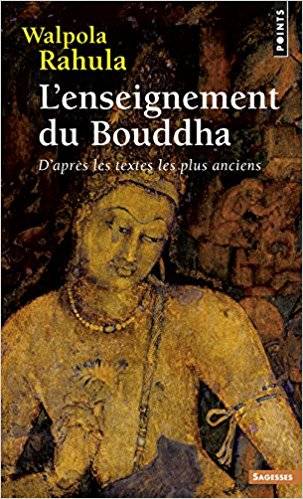 The Reverend Rahula received according to all the rules the traditional training of a Buddhist monk in Ceylon.
« the Tradition » (Agama) and in Pali « the Canonical Corpus » (Nikdya), to which Reverend Rahula, who has an unparalleled knowledge of them, refers constantly and almost exclusively.
Paul Demiéville
See also:
Theravada Buddhism
Representation of Buddha, the fat and the thin
Buddhism and politics
Source: wikipedia.org ; bouddhisme-universite.org[
Notice to Adblock users
Toutelathailande.fr is an independent media outlet financed solely by advertising.
Automatic and intrusive video formats have been removed for several months to improve your reading comfort.
If our articles are useful to you, you can support the site by disabling your blocker for this domain.
Useful links to prepare your trip to Thailand
Book bus, train and boat in Thailand
Manage your money while traveling with Wise
You can follow us on:
Twitter, LinkedIn, Facebook, Google News
Or install our app:
All Thailand Application on your smartphone

3 comments
Hello,
After my multiple searches, I still find other more attractive and inventive explanations as I go along to people who are looking for the truth. As the writings are not taken during and by the true intellectuals at the time of Gotama (not like the Christian writings that leave more certain traces) all these transmitted accounts drift little by little from one generation to another by friends who are more and more intellectual. Hinduism, created by the naive (scientifically), with higher degrees of spirit, interpret according to their reasoning or analysis according to, again, accounts heard from other naive people...etc...Everything is mixed up by Buddhism. Buddhism is already approved by science for the result in meditation...but the rest (cycle of life, incarnation... : before without beings on our earth without more scientific explanations, the naive continue to lead and convince and make believe..hence the more than 300 million Buddhists (including me since my birth, not anymore after having my more in-depth study on Christianity), especially with this name Love. I believe, based on "my father" (not to be ungrateful to him, the real existence) creator, the closest to me 67 years ago...Fortunately with these educational projects of true and only Divine, in our minimal way of analysis, if God gives us everything at birth, happiness, there will be no more intellectuals in all the research to find these solutions, there will be no more this name Gotama that suggests meditation... Well, to lead and deepen before concluding, as Buddha said, especially let's not fall into the traps of people who hide behind for their personal interests: proof: stories of sanghas in my country since last May with money !!!.
In fact, there are more questions about the origin of Christianity than Buddhism.
Great Christian scholars are still looking for evidence of the existence of Jesus, and his teachings are close to those given by the book of Enoch, which is believed to be of Sumerian origin.
After that, it's certain that the teachings of Buddha have been well transformed over the centuries, which is why I recommend the book by Reverend Rahula:
"The Teaching of Buddha according to the oldest texts".
Thank you very much! I found what I was looking for.
I am delighted with your article.