
Discover the various means of transport in Thailand as well as practical tips for using them effectively.
Few countries are as easy to get around: low-cost airlines, many four-lane highways allowing for fast road travel, buses, taxis, tuk tuks, and motorcycle taxis in abundance in cities…
During your trip to Thailand, you will have a wide range of options to get around.
Menu
Booking a bus, train, boat or flight ticket
You can get an idea of transportation prices in Thailand, check schedules or book your tickets with our partner: 12Go Asia.
Transport in Thailand: traveling by plane
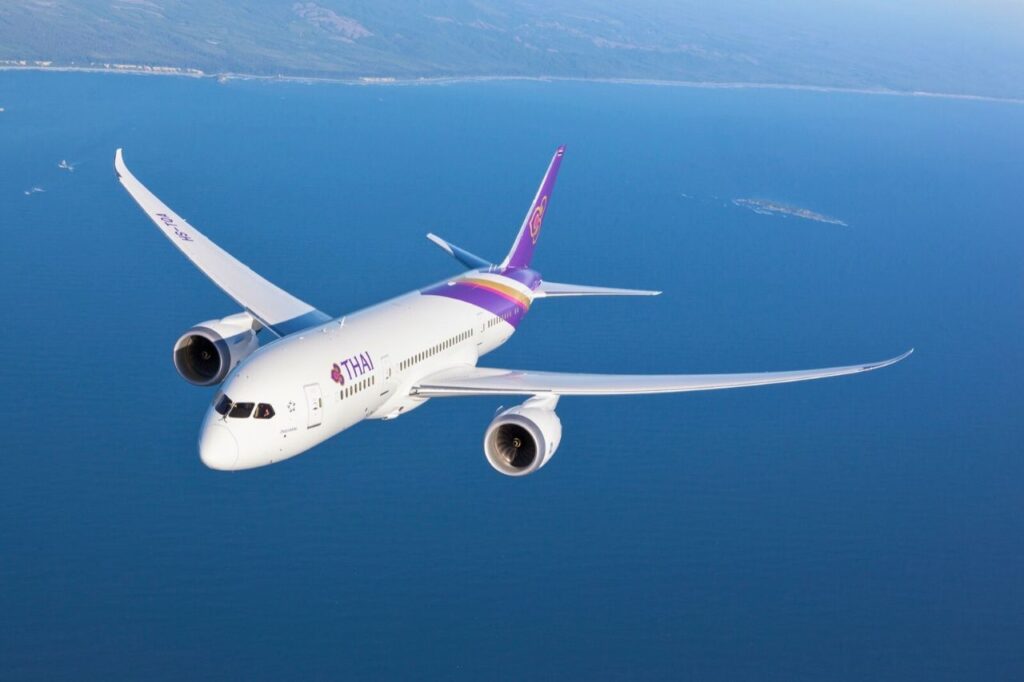
Boeing 787-8 Dreamliner of Thai Airways. Photo Spin9
Most major cities have an airport and are well served.
For Bangkok, note that there are two airports, Suvarnabhumi and Don Muang, don't get it wrong!
Suvarnabhumi, called Suvarnabhorn by the Thais, is the new airport, it is mainly dedicated to international flights.
Don Mueang, the old airport, mainly handles domestic or neighboring countries flights.
Enjoy low-cost prices!
With low-cost airlines like Air Asia, Vietjet Air or Nok Air, domestic flights become affordable even for small budgets.
However, baggage fees can drive up the total price.
Flight comparator
See our article:
How to find cheap flights: tips to know
Transport in Thailand: traveling by bus

Bus in Thailand.
It's the most used means of transport because it's fast, comfortable and inexpensive.
In addition, the country's road system is made up of many well-maintained 4-lane highways, which allows buses to travel at high speeds safely.
There is little traffic congestion, except sometimes when arriving in big cities.
Bring a warm clothing for the trips, some buses have full air conditioning.
Bus classes
There are several classes of buses, the cheapest ones are often crowded and stop at many stations.
In general, all destinations are indicated on the ticket counters in bus stations.
When you buy the ticket, you can ask to see a picture of the bus:
Dou loup rotmee day maille krap ? = Can I see a picture of the bus?
If you want to be sure to have a comfortable bus, ask for a VIP (pronounced: vee eye pee).
Most buses are VIP, comfortable, affordable, with air conditioning and a hostess who will offer you drinks and food throughout the journey.
There are also more and more 'super VIP' buses with fewer seats and more legroom.
Note that you should avoid putting your feet on the armrests of the bus, as this can be considered rude or insulting if your feet touch the people in front of you.
In Thai culture, touching someone with your feet is considered contempt or an insult!
See: Things to Do and Not to Do in Thailand
Bus stops
On long journeys, several rest stops are organized, even if there are often toilets on the bus.
Cela permet de marcher, fumer où de faire des achats dans un des magasins souvent liés à la compagnie de bus.
There is also sometimes a stop at a restaurant with a meal included in the ticket price, in this case, one of the tickets given to you is used to pay for the meal.
During these stops, remember the location of the bus, the driver's head, the hostess or other passengers.
Sometimes, your bus stops alone on the parking lot, you go to eat and when you come back, there are 20 identical buses with destinations indicated in Thai!
In general, the hostess recounts the number of passengers before departure.
Buses in Bangkok
Bangkok has 3 main bus terminals:
Mo Chit (Northern Bus Terminal) which mainly serves the northwest (Chiang Mai, Mae Hong Son, Chiang Rai…) and the northeast (Isan) of the country.
There are also lines going to the main cities of the south.
Sai Tai Taling Chan (Southern Bus Terminal) which serves the West (Kanchanaburi…) and South (Phuket, Krabi, Surat Thani…).
Note that this station is poorly served, it is better to go there by taxi or via Grab/Bolt.
Ekamai (Eastern Bus Terminal) which mainly serves the east of the country (Pattaya, Rayong, Trat…).
Transport in Thailand: traveling by train
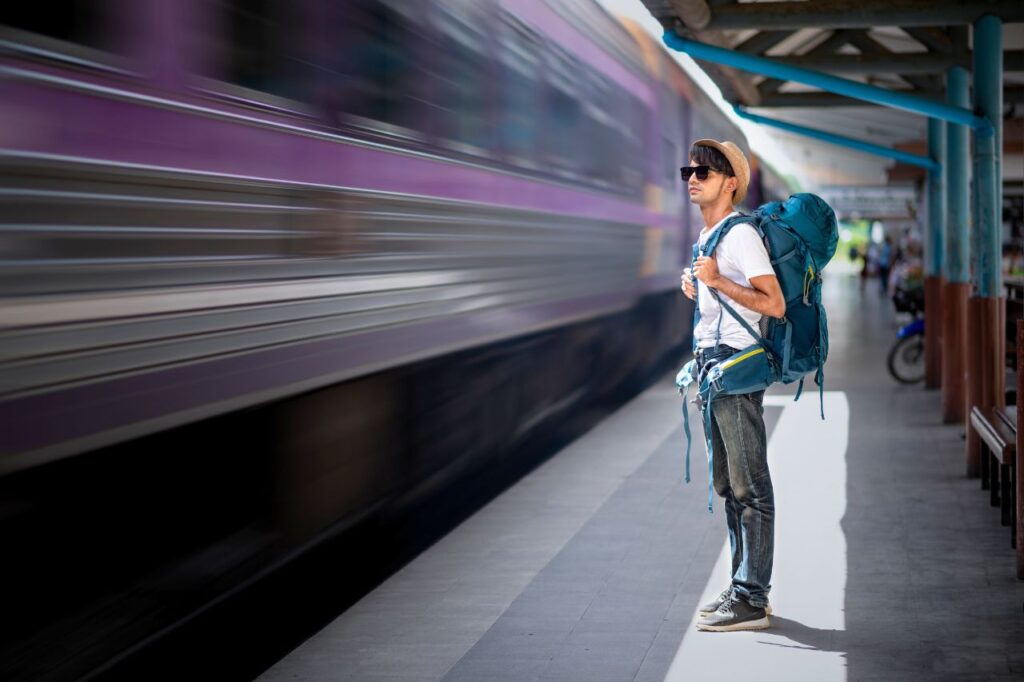
A train passes in front of a traveler at a train station in Thailand. Photo: Pakorn_Khantiyaporn
Thai trains are not very fast or punctual (often late) compared to buses, but it's a more comfortable (if you don't like sitting) and friendly way to get around.
The new central station of Bangkok, which replaces Hualamphong is Krung Thep Aphiwat.
See also: Train travel in Thailand: itineraries, tips and good deals
The Thai railway network is managed by the State Railway of Thailand (STR), you can check the schedules and book your tickets on their website: dticket.railway.co.th
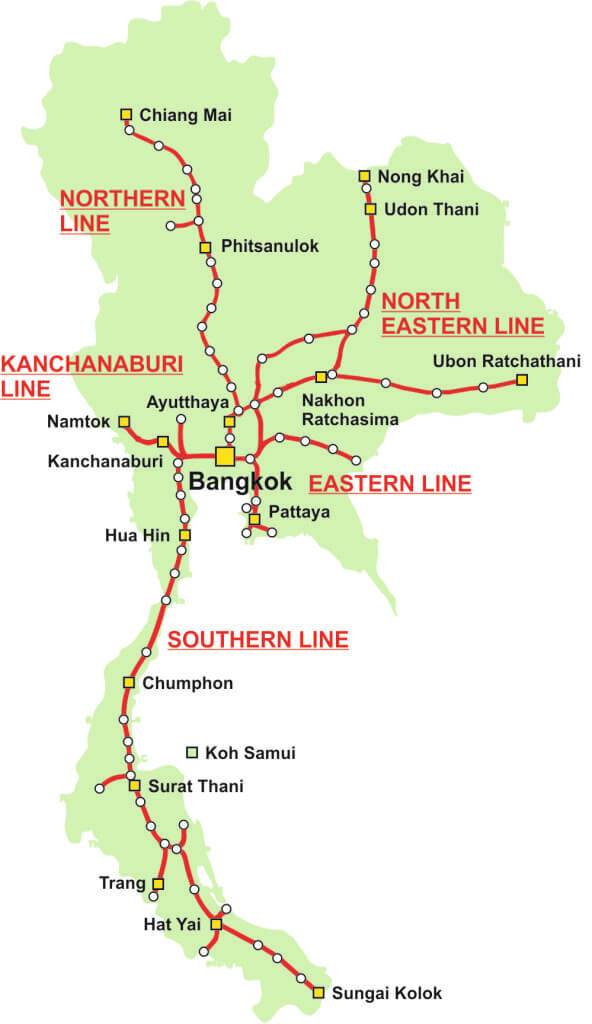
There are 5 main lines: the north line, the northeast line, the Kanchanaburi line, the east line and the south line.
Different classes
First class
Only fast trains, express and special express trains have first-class compartments.
The cabins are generally equipped with a sink, a small table, convertible benches into beds and adjustable air conditioning or a small fan.
Second class
Only fast and express trains are equipped with second classes. The cars are made up of comfortable seats facing the front of the train.
The second-class sleeper cars are cabins made up of convertible bunks into beds.
There are 4 beds per cabin and generally the lower beds cost more because they have more headroom than the upper beds.
Third class
Third-class carriages are equipped with facing benches, if the train is crowded, you can end up with more than 3 people on the benches!
Express trains do not have 3rd class.
Catering service
You can dine in the restaurant cars or at your seat by ordering the meal, but prices are generally high on trains.
It's better to buy food at the departure station where prices are fair.
There are also often street vendors.
Transport in Thailand: hitchhiking
It's not in Thai culture and if you thumb, few Thais will understand what you're doing.
Here, to stop a vehicle, you have to raise your arm up and move your hand up and down.
Public transportation is inexpensive and used by poor people as well.
If you hitchhike, it will be misunderstood and you risk being seen as a farang ki ngao, a miser.
Renting or buying a car or motorcycle
You can buy a used motorcycle and resell it after if you stay for a long time.
You can find used motorcycles in your area or post an ad on the aseannow.com forum.
The country's roads are in good condition, there are many service stations with seven eleven (food, beverage, medicine stores...) or other businesses open 24/7, very convenient if you travel at night.
In the villages, many small shops offer glass bottles filled with fuel, generally, they are on a display stand in front of the store.

Be very careful on the road!
If you decide to rent a car or a motorcycle to get around the country, you must know that the biggest danger in Thailand is the road!
See:
Thailand, world champion of deaths on two wheels
Here, we drive on the left and changing sides completely changes our perception and reflex regarding the use of roads.
You should also keep in mind that the road code is not known by many drivers.
The rule is to let the largest vehicle pass, large 4x4s are dangerous even when you cross the road.
Some drivers think they're allowed to do anything and forcing them to stop is a very bad idea!
The Thai, so polite and pleasant in everyday life, can turn into a fierce beast on the road!
You should also be very careful with bus and truck drivers, who often work beyond their limits and sometimes take Yabaa (methamphetamine) to keep going.
When I took my motorbike license in Thailand, there was a multiple-choice question with a touch of humor about it.
The question was 'what to do in case of fatigue' and among the answers, there was 'stop to have a coffee', 'stop to sleep' or 'take Yabaa'!
There are often motorcycles going in the opposite direction on the side of the road, because this allows them to avoid making a big detour.
On a motorcycle, you must wear a helmet under penalty of a fine (around 200 bahts), you should know that many Thais do not wear a helmet to preserve their hairstyles!
Insurance
You must have civil liability insurance if you drive in Thailand.
Rental agencies generally offer insurance, make sure to check before renting, because without insurance, you risk having big problems in case of an accident.
See: Travel insurance: why a bank card is not enough
Driving license
You must have an international driver's license if you rent a car or motorcycle.
If you're caught by the police without a license, you'll have the choice to pay a bribe or a more expensive fine.
Renting or buying a bicycle
In tourist cities, it is quite easy to find bicycles for rent.
Another solution if you stay for a long time is to buy one and resell it when you leave.
You can also find used bicycles or post ads on the ASEAN Now forum.
There are bicycle shops in most major cities, Thai people are cycling enthusiasts and it's possible to find the biggest bicycle brands in the country.
You can easily take the train, bus, songtaew or tuk tuk with your bike.
But, be careful in buses and songtaews, if your bike is placed on the roof, make sure the driver doesn't put heavy objects on it.
And as with motorcycles, you must be very careful on the road and be wary of large vehicles that act as if they have priority in all situations!
Urban transport in Thailand
If you use sam lo, tuk tuk, moto taxi and taxi, you must always agree on the fare before boarding, except for taxi-meter and Grab or Bolt taxis.
Urban buses
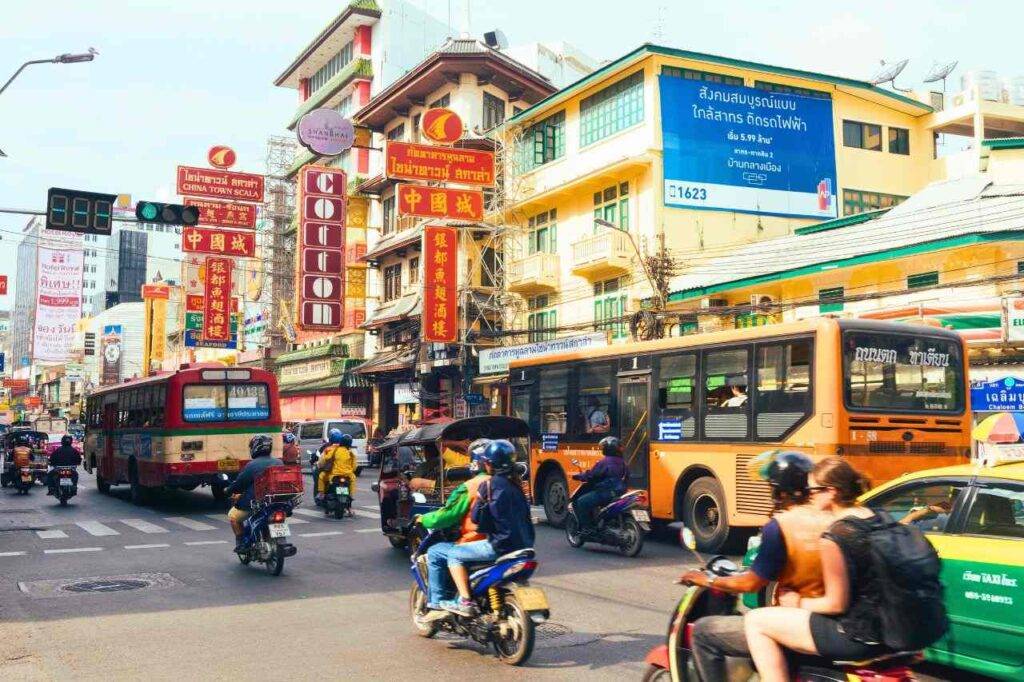
In Bangkok and other major cities in the country, there are urban bus networks.
It's the most economical way to get around, but it's not suitable for tourists, there are often no English signs and they are often crowded.
The cyclo-pousse (sam lo)
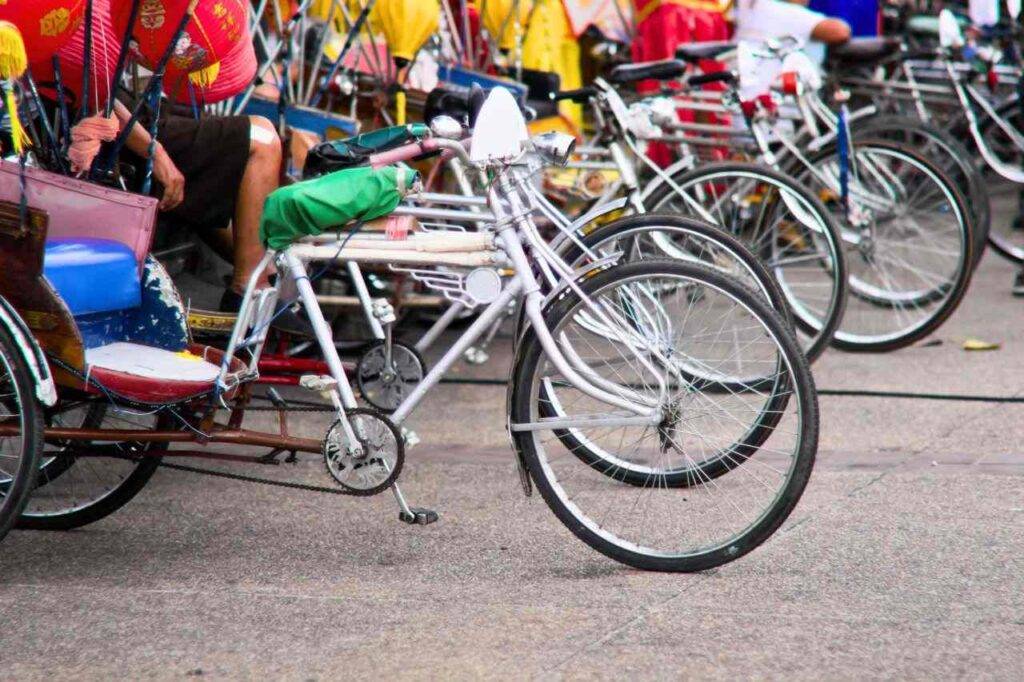
Cyclo-pousse in Chiang Mai. Photo: Toa55
Sam lo means three wheels (sam = three; lo = wheel), these are cyclo-pousse that can make short journeys.
A quiet and ecological way to travel short distances.
The tuk tuks
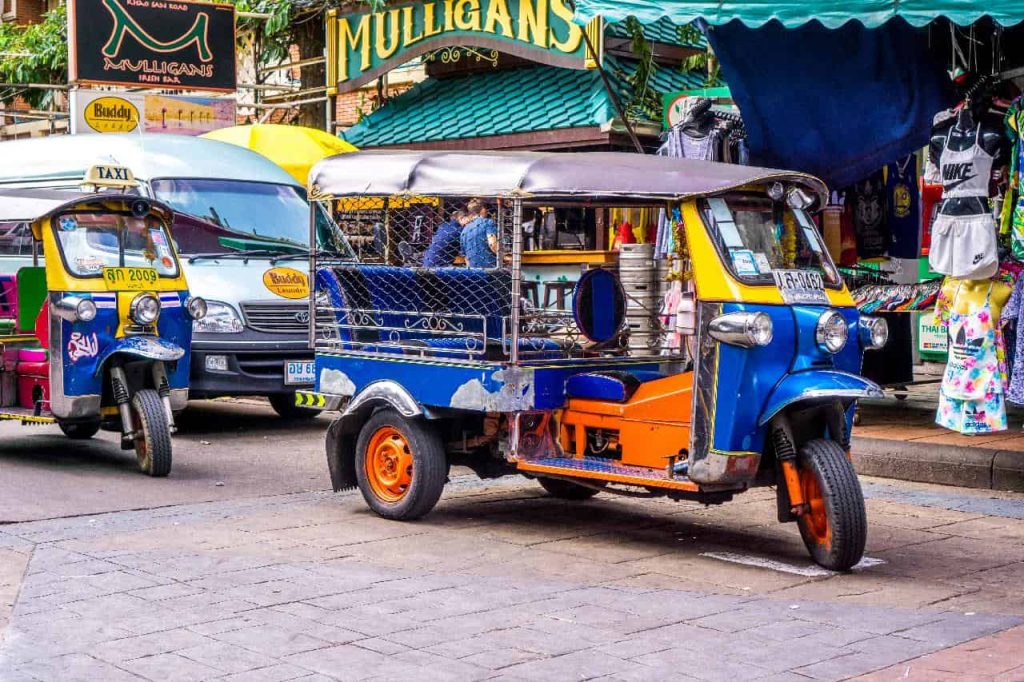
Tuk Tuk in a street in Bangkok.
It's one of the symbols of travel in Thailand. 'Tuk tuk' is the repetition of the word 'tuk' (or rather 'touk') which means 'not expensive'.
But in fact, the price (for tourists) is often much more expensive than the price of a taxi.
It's up to the customer and you really have to love the 'so sweet' noise of the engine and exhaust fumes!
Motorcycle taxis

A passenger behind a moto-taxi in Thailand. Photo: BK
It's a fast and inexpensive way to get around, very handy when there are traffic jams, but it can be dangerous, especially in Bangkok where drivers drive like madmen!
If you have a large backpack, ask the driver to put it between their legs, sometimes they will offer to take it themselves, it's uncomfortable and even dangerous to keep it on your back.
You can also find much more affordable motorbike taxis on the Grab and Bolt apps, see below.
Taxis
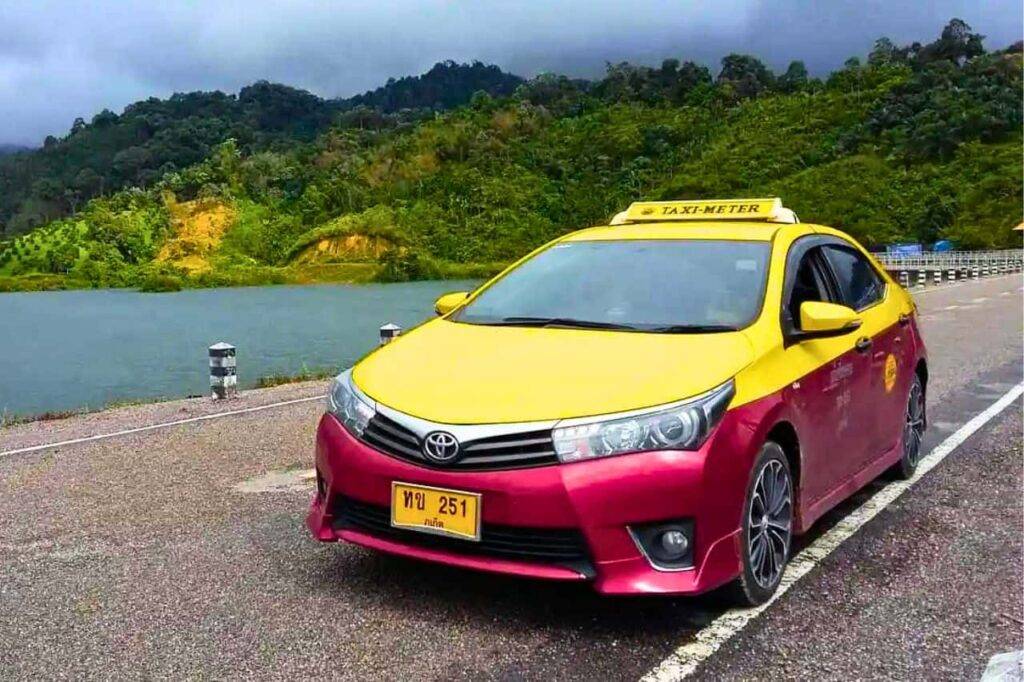
Taxi on the island of Phuket. Photo: Find Taxi Phuket – Facebook
It's one of the most comfortable ways to get around.
When you get into the taxi, ask the driver if it's a taxi-meter and make sure they turn on the meter.
Make sure you always have some change to pay, taxis never have any.
Sometimes, the taxi will ask you if you want to take the toll road in Bangkok, if you agree, it will ask you for money to pay for it, it's not very expensive and reduces the duration of the ride.
Grab and Bolt taxis and motorcycle taxis
Faced with numerous problems with taxis, many of which refuse to use the meter and offer high rates, many Thais and tourists use applications like Grab or Bolt to get around.
See: Thailand has received more than 10,600 complaints against taxis
Grab taxis are generally cheaper than normal taxis and Bolt taxis are much cheaper than Grab taxis, but they can be harder to find in some places.
The best thing is to download both applications, first look for Bolt taxis, and if you can't find any, search on Grab.
Songtaew (two benches)


Songtaew or song teu means two benches (song = two; taew = bench), these are adapted pick-up trucks.
An economical way to get around cities and villages.
In some small towns, it's often the only way to reach the city.
The price of the journey in town is often between 10 and 30 bahts, you need to indicate your destination to the driver.
In general, there is a bell on the ceiling to stop the vehicle, you pay once you arrive.
The subways
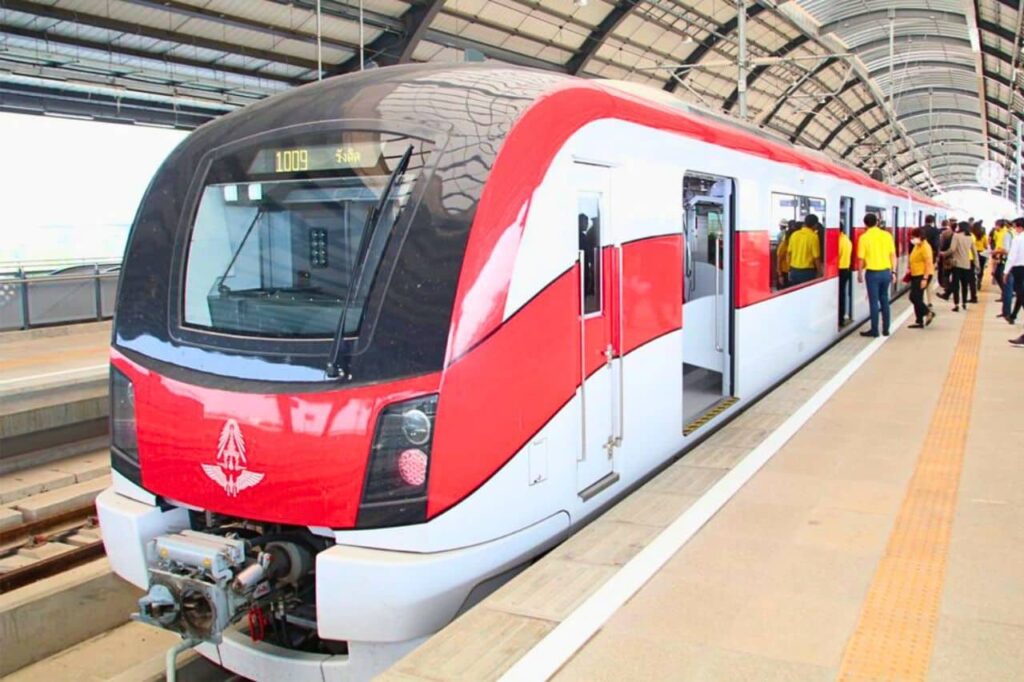
Red line of Bangkok.
Bangkok is the only Thai city with an underground metro, the MRT, and an elevated metro, the BTS.
It's an economical and quick way to get around, also avoiding traffic jams.
For more information with the metro map, see:
Guide to Bangkok Metro: BTS, MRT and others
The boats
 It's the essential way to reach the islands of Thailand, except those with an airport.
Depending on the island's popularity, there are different types of boats, express boats, ferries, catamarans…
In Bangkok and its surroundings, there are long-tail boats that allow you to move quickly through rivers and canals.
For more information with route maps, see: Transportation in Bangkok.
See also:
Bangkok to Chiang Mai by train, bus or plane
VIP Bus from Suvarnabhumi Airport to Pattaya and Hua Hin
Photos: Bus: Flying Pharmacist; bus in Bangkok: Nutjaru; boeing: Arpingstone, boats: Jpatokai; elephant: Ganeshapark; Source: tourismthailand.org
Do you like Toutelathailande.fr?
👉 Leave us a review on Trustpilot.
Your review strengthens the credibility of our work and the trust of our readers.
Useful links to prepare your trip to Thailand
Book bus, train and boat in Thailand
Manage your money while traveling with Wise
If our news, tourist information, or cultural content has been useful to you and you'd like to thank us:
You can follow us on:
Twitter, LinkedIn, Facebook,Google News
Or install our application: Install the application of All Thailand on your smartphone

3 comments
Hello everyone,
I stayed in Bangkok for 4 months last year,
the first 10 days were spent between motorbike taxis that made up prices (e.g. to go from point A to point B was 60 baht, and for the same journey in the opposite direction, i.e. from point B to point A, it was 150 baht) and tuk-tuks that gave me a headache with the noise of their engines when I was sitting comfortably in the back, and the BTS and MRT that only serve the main roads of Bangkok.
On the 11th day, I said stop!!!!!
I rented a scooter and was able to really enjoy the city.
At first, although I am a very good two-wheeler driver, I still went slowly,
we're talking about driving in Bangkok.
Once you get used to the driving of road users and the whole environment, it's simpler than it seems.
(Little tip, it's not necessary to know the city well, my phone's GPS took me to all the addresses I had to go to.)
I rented from 2 agencies during the 4 months with whom it went super well and above all, they didn't keep your passport as a guarantee.
I was relieved to no longer see my budget being absorbed every day by the slightest little move.
Hi Enzi,
To get around Bangkok, the most comfortable and economical means is the taxi meter, cheaper than tuk-tuks and motorcycle taxis that scam foreigners.
You just have to, as said in the article, make sure they put the meter on.
Then there are the crowded buses for the bravest and most resourceful.
But the motorcycle, indeed, when mastered well, is a good solution.
Hello, can you rent electric bicycles on the island of Ko Phangan? If not, how much does the ferry ticket cost from Samui to Ko Phangan for one person with a bike?
Thank you for your response